Food Processing to Play a Decisive Role in Realising the Vision of Viksit Bharat : Union Minister Shri Chirag Paswan
Food Processing to Play a Decisive Role in Realising the Vision of Viksit Bharat : Union Minister Shri Chirag Paswan
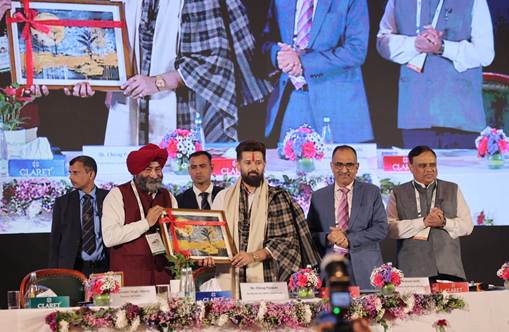
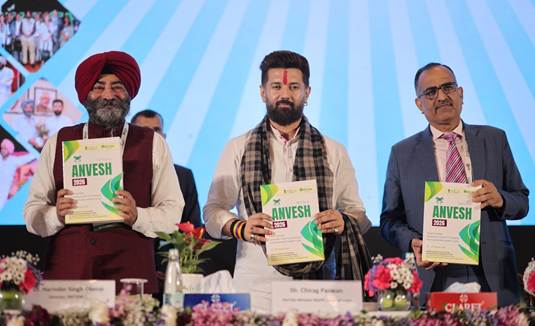
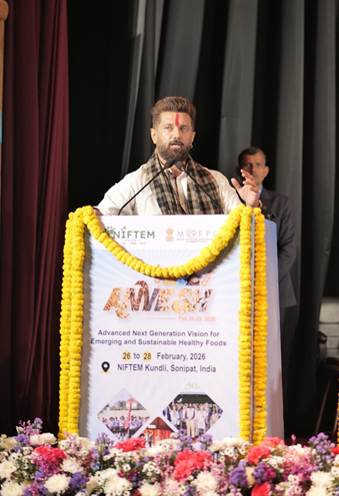
The “International Conference on Advanced Next Generation Vision for Emerging and Sustainable Healthy Foods (ANVESH–2026)” was inaugurated today at National Institute of Food Technology Entrepreneurship and Management (NIFTEM–Kundli). The three-day international conference is witnessing participation from experts, researchers, industry representatives, exporters, entrepreneurs and policymakers from more than 25 countries.
Addressing the inaugural session, the Union Minister for Food Processing Industries Chirag Paswan stated that the food processing sector will play a crucial role in realising the vision of Viksit Bharat–2047 envisioned by the Hon’ble Prime Minister Narendra Modi. He emphasised that for a nation of 1.4 billion people, technology-driven development is imperative. Innovations, research and modern technologies must be taken to rural areas and farmers to bridge the gap between villages and cities.
Highlighting changing consumer lifestyles, the Minister noted the growing demand for Ready-to-Eat (RTE) and Ready-to-Cook products, which are integral to the expansion of the food processing sector. While India has significant production volume, he stressed the need to focus on value addition. He recalled that 11 years ago, 100% FDI was permitted in trading, including e-commerce, of food products manufactured or produced in India to boost value addition, enhance farmers’ income and position India as a global food basket.
He further stated that the goal should be to ensure that Indian food products are present on every dining table across the world. There can be no compromise on quality and regulatory standards if Indian standards are to gain global recognition. He added that India has signed Free Trade Agreements (FTAs) with 23 countries while safeguarding farmers’ interests and called for dispelling false narratives surrounding the food processing sector.
On the occasion, Avinash Joshi, Secretary, Ministry of Food Processing Industries, said that ‘ANVESH’ signifies “Exploration and Acquire.” He described NIFTEM as an example of sustainability and healthy food systems. He stated that the Production Linked Incentive (PLI) Scheme for Food Processing is one of the shining performers among the 14 PLI schemes.
The Secretary further informed that out of the total outlay of ₹10,900 crore under the PLI scheme for food processing, ₹2,625.04 crore has been released so far, which constitutes approximately 24% of the total allocation. Against the targeted employment generation of 2.5 lakh under the scheme, 3.29 lakh jobs have already been created, achieving 131% of the target and reflecting the scheme’s significant success.
Shakuntala Haraksingh Thilsted, World Food Prize Laureate, emphasised the need for action-oriented and solution-based approaches in food processing while ensuring sustainability of the planet.
T. G. Sitharam, former Chairman of AICTE, stated that India is emerging as a global leader in science and technology, which aligns with the vision of a developed India.
Harinder Singh Oberoi, Director, NIFTEM–Kundli, highlighted that ANVESH–2026 provides a global platform for knowledge exchange, technological collaboration and shared learning. He noted that international technological collaboration is essential for India to establish global leadership in food processing.
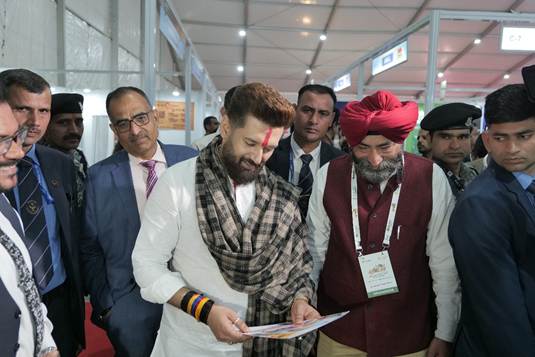
Earlier, the Union Minister visited the ANVESH–2026 exhibition and reviewed new technologies, innovations and products showcased at the event.
The conference is witnessing participation from over 1,000 delegates. Over the next three days, plenary sessions, keynote lectures, panel discussions, exhibitions and industry interactions will be organised. The conference aims to deliberate on emerging advancements in food processing, value addition, digital compliance systems, sustainable supply chains, export-oriented innovation, product diversification, food safety, traceability and future-ready agri-food entrepreneurial ecosystems.