TRAI Marks Foundation Day 2026 with High-Level Deliberations on Inclusive TV Access and Network Slicing
TRAI Marks Foundation Day 2026 with High-Level Deliberations on Inclusive TV Access and Network Slicing
The Telecom Regulatory Authority of India (TRAI) today commemorated TRAI Day 2026, marking 29 years of the establishment of the TRAI on 20th February 1997. The event was attended by senior government officials, industry leaders, academia and technology experts to deliberate on emerging issues shaping India’s digital communications landscape.
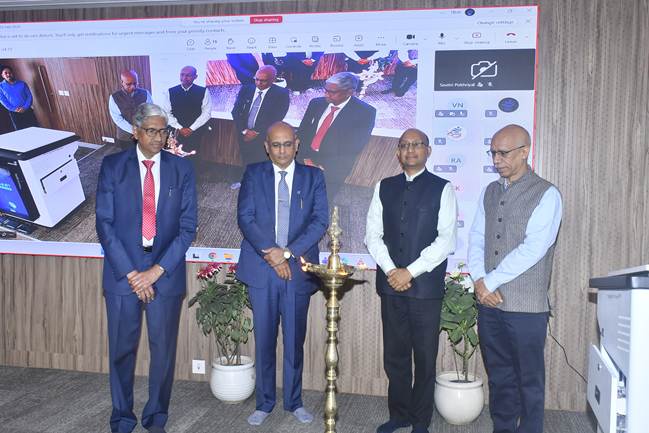
The celebration combined reflection of outstanding work done by TRAI in shaping the Telecommunication and broadcasting landscape in all these years. There were also technical discussions on two topics “Taking TV to all Homes: Policy, Technology and Business strategies for inclusion” and “Network slicing and Net neutrality”. The event commenced with the ceremonial lighting of the lamp by Shri Anil Kumar Lahoti, Chairperson, TRAI, in the presence of Shri Ritu Ranjan Mittar, Member (M), Dr M.P. Tangirala, Member (T), and Prof. Ranjan Bose, Member (PT).
Delivering the welcome address, Shri Atul Kumar Chaudhary, Secretary, TRAI, recalled the establishment of the Authority in 1997 during India’s transition to a competitive telecom market and highlighted the importance of an independent regulator in ensuring fair play, orderly growth and protection of consumer interests. He underscored the continued relevance of television as a widely accessible medium, particularly in rural and semi-urban regions, and emphasized that universal access to broadcasting remains integral to social inclusion. He also noted the rapid evolution of telecom technologies, including network slicing, and stressed the need to preserve openness and adhere to the principles of net neutrality as advanced capabilities are deployed.
Members of the Authority also reflected on TRAI’s evolving regulatory philosophy and its institutional role in steering India’s communications ecosystem through successive technological transitions.
Shri Ritu Ranjan Mittar, Member (M), highlighted the importance of market-based regulatory frameworks in sustaining competition and investment in the telecom sector. He emphasised that transparent consultation processes, tariff rationalisation, spectrum efficiency and promotion of innovation have been central to maintaining affordability while ensuring long-term sectoral sustainability. He noted that as networks become more data-intensive and service-oriented, regulatory agility and predictability will be key to maintaining investor confidence and consumer welfare.
Dr. M.P. Tangirala, Member (T), underscored the technological dimensions of regulation, particularly in the context of next-generation networks, AI-enabled systems and advanced spectrum utilisation. He stressed that regulatory frameworks must evolve in tandem with technological innovation, especially in areas such as network slicing, Quality of Service (QoS), interoperability and digital infrastructure resilience. He reiterated that technical standardisation, evidence-based regulation and data-driven oversight remain critical to ensuring robust and secure communications networks.
Prof. Ranjan Bose, Member (Part-Time), brought an academic and research perspective to the deliberations. He highlighted the importance of institutional collaboration between regulators, academia and industry in fostering innovation ecosystems. He emphasised that emerging technologies such as Artificial Intelligence, 6G research and digital platforms require interdisciplinary thinking and forward-looking regulatory design. He also noted that regulatory sandboxes, pilot initiatives and research partnerships can serve as effective instruments to test new models while safeguarding public interest.
Shri Neelkanth Mishra, Member (Part-Time), reflected on the broader macro-economic significance of the telecom and broadcasting sectors in India’s growth trajectory. He emphasised that digital infrastructure today forms the backbone of productivity enhancement, financial inclusion and digital public infrastructure. He noted that predictable and credible regulation plays a crucial role in attracting long-term capital into network expansion, fiber deployment and emerging technologies. Highlighting the importance of balancing innovation with financial sustainability, he observed that regulatory clarity, efficient capital allocation and competitive neutrality will be critical in enabling the sector to support India’s ambition of becoming a leading digital economy. He also underscored the need for regulatory foresight in assessing the economic implications of new technologies such as AI-driven networks, satellite broadband and next-generation digital platforms.
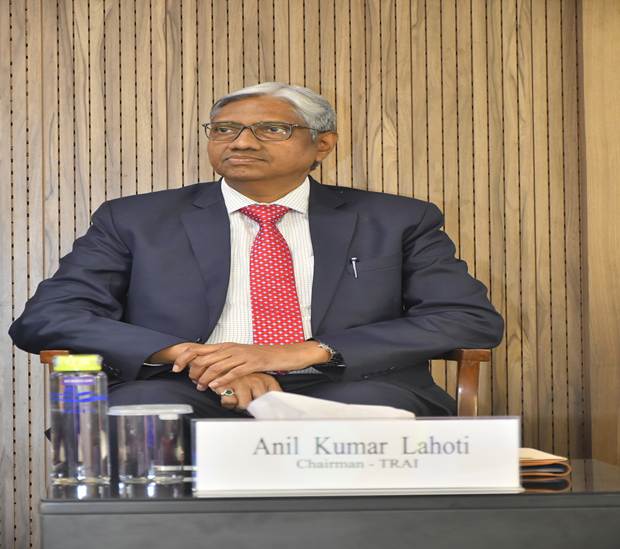
Sh Anil Kumar Lahoti at TRAI Day 2026
In his opening address, Shri Anil Kumar Lahoti, Chairman, TRAI, reflected on the Authority’s role as a regulatory institution ensuring a level playing field and orderly growth across India’s telecom and broadcasting sectors. He highlighted how connectivity today spans fixed line, mobile, optical fiber and satellite networks, enabling services across the country. Emphasizing the sector’s next phase of evolution, he stated, “Technologies such as Artificial Intelligence, 5G and future 6G networks are redefining network architecture and service delivery. As these systems evolve, it is essential that our regulatory frameworks remain adaptive and transparent, ensuring fairness, accountability and the protection of consumer interest while enabling innovation.” He expressed confidence that as India stands at the cusp of new technological frontiers, balanced and forward-looking regulation will continue to support inclusive digital growth.
A video message by the Shri Jyotiraditya M. Scindia, Hon’ble Minister of Communications (MoC) was shared during the inaugural session. In his address, he congratulated TRAI on its 29th Foundation Day and underscored the Authority’s role as a bedrock institution ensuring fairness, equity and a level playing field across India’s communications ecosystem. Highlighting the rapid evolution from 4G to 5G, the advent of 6G and Artificial Intelligence, he stated, “As new technologies redefine the communications landscape, it is essential that we put in place the right regulatory guardrails to foster innovation while preserving fairness, transparency and public interest.” He also appreciated the fact that a technical discussion on network slicing has been included in the technical discourse of the day.
The inaugural session concluded with a vote of thanks by the Shri Ashok Kumar Jha, Principal Advisor (Broadcasting & Cable Services), TRAI.
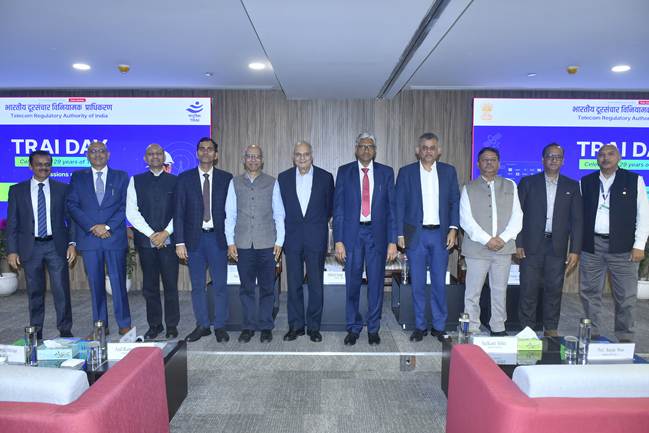
Technical Session 1 on Taking TV to All Homes at TRAI Day 2026
The first technical session, “Taking Television to All Homes – Policy, Technology and Business Strategies for Inclusion”, was moderated by Shri Ashok Kumar Jha, Principal Advisor (B&CS), TRAI. The session examined strategies to enhance television accessibility, strengthen last-mile connectivity and bridge the digital divide, particularly in rural and underserved regions. Speakers included Shri Prabhat, Additional Secretary, Ministry of Information & Broadcasting, Mr. Padma Kumar, CEO KCCL and Prof. Vishwanath Pingali, IIM Ahmedabad. The deliberations highlighted the continuing relevance of broadcasting as a widely accessible medium and explored policy and technology interventions necessary for universal service delivery. Discussions also addressed sustainable business models to expand reach while ensuring affordability and service quality.
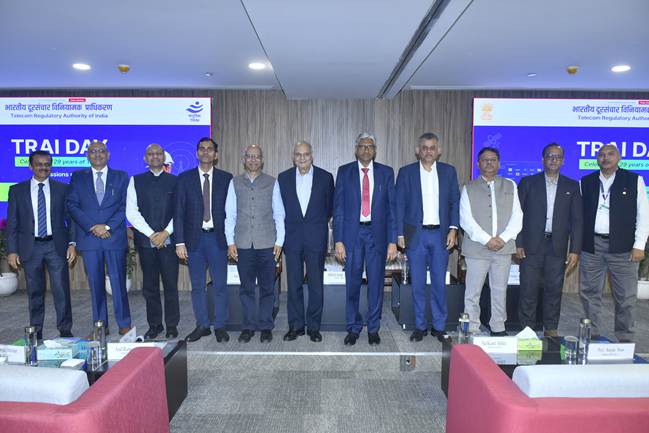
Technical Session 2 on Network Slicing and Net Neutrality at TRAI Day 2026
The second session, “Network Slicing and Net Neutrality”, moderated by Shri Akhilesh Trivedi, Advisor (NSL-II), TRAI, focused on the regulatory and technological dimensions of network slicing with the principles of an open and non-discriminatory internet. Speakers included Shri U.K. Srivastava, President, Reliance Jio Infocom Limited, Mr. Umang Jindal, Ericsson and Mr. Anil Tandon, Broadband India Forum. The discussion examined differentiated service provisioning in advanced networks and evolving network architectures. It also addressed the need to balance innovation with consumer rights and equitable access to digital services.
The deliberations witnessed active participation from policymakers, industry representatives and academia, reinforcing the importance of stakeholder consultation in shaping responsive and balanced regulation.
TRAI Day 2026 reaffirmed the Authority’s commitment to fostering inclusive growth, safeguarding consumer interests, promoting fair competition and supporting resilient, secure and future-ready telecom and broadcasting services in India.
For further information or clarifications, please contact Dr. Deepali Sharma, Advisor (Broadcasting and Cable Services (B&CS), TRAI, at advbcs-2@trai.gov.in.
X (formerly Twitter) – @TRAI
Facebook – @TRAI
Instagram – @trai.official_
LinkedIn – @trai-official
YouTube – @TelecomRegulatoryAuthorityofIndia
Website – trai.gov.in