Restoring Indigenous Fish Stocks in River Ganga through Scientific River Ranching
Restoring Indigenous Fish Stocks in River Ganga through Scientific River Ranching
Key Takeaways
Background and Rationale
For much of the past century, the Ganga has carried more than water. It has sustained livelihoods, fed communities, and anchored a dense web of biodiversity along its course. In recent decades, however, the river’s native fish have thinned – casualties of habitat degradation, altered flow regimes, pollution and relentless, often unregulated fishing pressure.
Over the last 10 years, a quieter effort has been underway to reverse that decline. Under the Government of India’s Namami Gange Programme, the ICAR–Central Inland Fisheries Research Institute (ICAR-CIFRI) has carried out a large-scale programme of scientific river ranching – an intervention designed not merely to restock the river, but to restore its ecological balance.
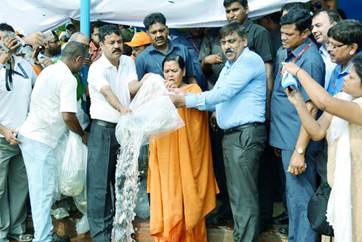
Ranching by Former Union Minister for Water Resources, River Development and Ganga Rejuvenation, Sushri Uma Bharati at Barrackpore on 26th May 2017
The Scale of the Intervention
Between 2017 and 2025, ICAR-CIFRI organised 169 river ranching programmes across ecologically critical stretches of the Ganga and its tributaries. In that period, 205.5 lakh seeds of indigenous fish species were released into selected river segments. The emphasis has remained firmly on native species conservation, preservation of genetic integrity, and the long-term sustainability of riverine fisheries.
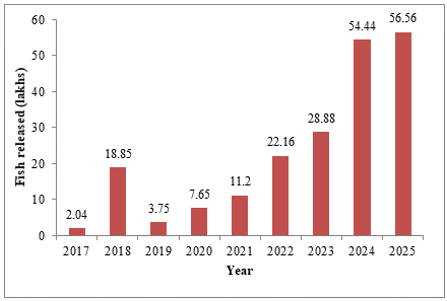
Impact of Ranching programmes
The programme has covered a wide range of indigenous species, including:
To improve survival rates after release, the institute stocked the river with fingerlings and advanced fingerlings measuring 10–15 centimeters in length, with an average body weight of 100–120 grams. These were not generic hatchery fish. The seed were artificially bred from wild brooders collected directly from the Ganga, a step intended to safeguard native genetic lines. Before release, the fish were reared under controlled hatchery and nursery conditions to enhance their adaptability in natural waters.
A Targeted Geographic Strategy
The spatial distribution of these efforts reveals a deliberate strategy. Ranching was concentrated in stretches where ecological value and livelihood dependence intersect most sharply.
State-wise distribution of the 169 interventions during the reporting period shows:
The concentration in West Bengal reflects both the ecological importance of its river stretches and the intensity of fishing activity in the lower reaches of the basin.
Measurable Gains
While ecological restoration is often measured over generations, early results suggest tangible gains. Fish landings of Indian Major Carps, a key indicator species group, have risen noticeably at major riverine centres.
These improvements are largely attributed to sustained ranching interventions combined with associated conservation measures implemented under the Namami Gange Programme.
Beyond numerical increases, the initiative has helped rebuild native fish populations, strengthen the resilience of riverine ecosystems, and support the livelihoods of dependent fishing communities. It has also reinforced the role of science-based management in the stewardship of open-water fisheries.
Did You Know?
Reservoir fisheries management guidelines helped raise average productivity from 20 to 150 kg/ha/year, while wetland productivity increased from 600 to 1,600 kg/ha/year. These efforts culminated in the formulation of national reservoir fisheries management policy guidelines in 2025.
Leadership, Visibility and Public Engagement
Several of the ranching events were conducted in the presence of senior public representatives and policymakers, a signal of the national importance attached to restoring riverine biodiversity. These occasions doubled as platforms for:
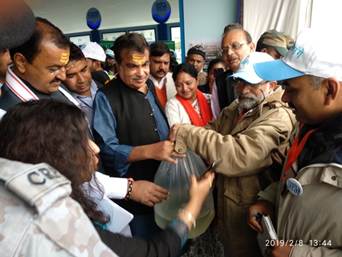
Ranching by Shri Nitin Gadkari, Minister for Road Transport & Highways, at Praygraj on 8th November, 2019
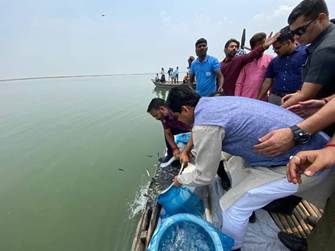
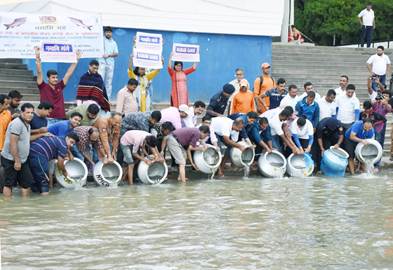
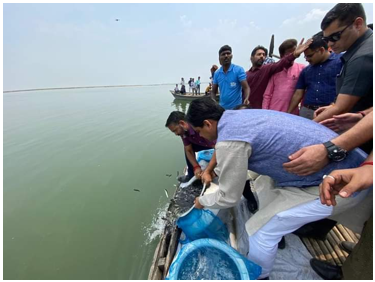
Ranching by Shri Shantanu Thakur, Union Minister of State for Ports, Shipping & Waterways, at Sahibganj, Jharkhand on 24th April 2023
An Institution with Deep Roots
Established in March 1947 at Barrackpore, West Bengal, ICAR-CIFRI has long been central to the evolution of inland fisheries research in India. What began as production-oriented research has matured into a broader ecosystem-based approach that integrates sustainability, conservation, livelihoods and nutritional security.
Did You Know?
The institute produced many stalwarts in the field of fisheries. ICAR-CIFRI’s alumni Dr. V.G. Jhingran and Dr. S. Ayyappan are the only recipients of the Padamshri award in the country’s fisheries fraternity.
River ranching sits within a larger scientific mandate that includes river and estuarine fisheries restoration, habitat characterisation, catch estimation, ecosystem services valuation, climate resilience research and policy support for inland open waters.
A Legacy of Scientific Stewardship
ICAR-CIFRI has developed enclosure culture technologies with diversified high value fish species like Ompok bimaculatus, Labeo bata, Systomus sarana Labeo rohita, Labeo rohita (Jayanti), Labeo gonius, Osteobrama belengari, Cyprinus carpio haematopterus and Etroplus suratensis,etc. at different geographical locations for increasing profitability and adoptability of cage farming.
Indian Inland Fisheries Informatics (INNF)
ICAR-CIFRI’s Indian Inland Fisheries Informatics (INNF) revolutionises India’s inland fisheries management through an integrated cloud platform combining machine learning, geospatial analytics, and data science.
Core Capabilities:
The Road Ahead
The experience of the past decade suggests that river restoration is neither rhetorical nor symbolic. When evidence-based interventions are aligned with ecological principles and supported by long-term monitoring, they can produce measurable outcomes.
Scientific river ranching under the Namami Gange Programme demonstrates that depleted native fish stocks can be replenished without compromising genetic integrity or ecological balance. The task now is continuity – scaling such initiatives, sustaining research, deepening stakeholder participation and refining adaptive management. The future of river Ganga’s biodiversity and fisheries potential will depend not on one season of stocking, but on persistent stewardship grounded in science.
References
Press Information Bureau: