MoSPI organized a National Level Consultative Workshop on “Using Administrative Data for Governance: Harmonizing Departmental Data at the State/UT Level” on 24th February 2026
MoSPI organized a National Level Consultative Workshop on “Using Administrative Data for Governance: Harmonizing Departmental Data at the State/UT Level” on 24th February 2026
The Ministry of Statistics and Programme Implementation (MoSPI) organized a National Level Consultative Workshop on “Using Administrative Data for Governance: Harmonizing Departmental Data at State Level” with States and UTs along with Central Ministries/Departments and other stakeholders on 24th February 2026 at Vigyan Bhawan New Delhi.
The workshop is a part of the preparatory process for the forthcoming National-Level Deliberative Summit “Data for Development” with States/UTs and other stakeholders on “Using Administrative Data for Governance: Harmonizing Departmental Data at State Level” in the month of April, 2026 which MoSPI would be organizing as a follow up of the 5th National Conference of Chief Secretaries of State/UT held in December 2025.
The summit seeks to advance a structured national agenda for strengthening administrative data systems and enabling responsible data harmonization across departments at the State/UT level.
The workshop aimed at briefing States/UTs on the objectives, scope and key issues for deliberations at subsequent State level internal workshops they would be organizing in next few weeks. Senior Officers Centre & State/UTs and experts from international agencies, think tanks as well as other stakeholders deliberated on various aspects of harmonization of administrative data, and showcased a few successful use cases in the workshop. The inputs emerged from State level workshops will be deliberated upon in the national level summit in April 2026 to identify the priority reform areas on the subject.
The inaugural session of the workshop was addressed by S. Krishnan, Secretary, Ministry of Electronics and Information Technology; Debjani Ghosh, Distinguished Fellow, NITI Aayog; Thomas Danielewitz, Senior Economist, World Bank; Dr. Saurabh Garg, Secretary, Ministry of Statistics and Programme Implementation and Director General (Data Governance), MoSPI.
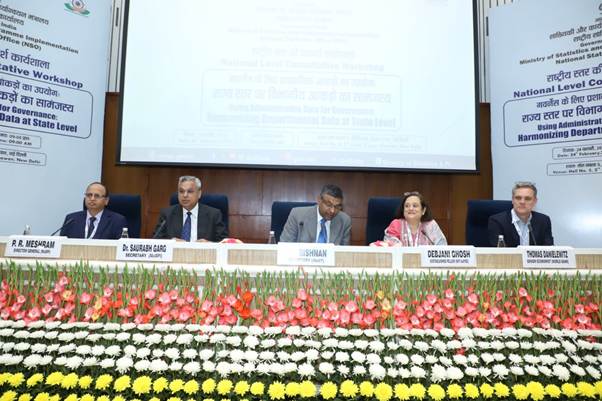
Shri S Krishnan, Secretary, MeitY highlighted the importance of breaking data silos across government departments and of expanding data accessibility beyond centralised systems to State & district administrators and field functionaries. He stressed the need for an improved machine readability, and real-time analytics to enhance monitoring and implementation. He underscored that the interoperability and responsible data sharing will strengthen evidence-based governance.
Ms. Debjani Ghosh, Distinguished Fellow NITI Aayog spoke about the shift from efficiency-driven globalisation to an “era of intelligence,” where data must be transformed into actionable insights. She underlined that accessibility, interoperability, and trust in data are essential to democratise intelligence and enable real-time decision-making at the grassroots level. She said we are now entering in the era of intelligence and the real power of intelligence is in democratisation.
Mr. Thomas Danielwitz Senior Economist World Bank described data as core infrastructure for the AI revolution and highlighted the importance of integrating decentralised digital datasets. He noted that seamless data integration can reduce compliance burdens on citizens and businesses while generating efficiency gains and cost savings.
Dr. Saurabh Garg, Secretary, MoSPI concluded the session by reiterating the Hon’ble Prime Minister’s vision of making civil servants “data enthusiasts” and ensuring that data is actively used rather than stored in isolation. He asked States to conduct workshops at State/District levels for wider consultations in the effort to institutionalise data-driven governance.
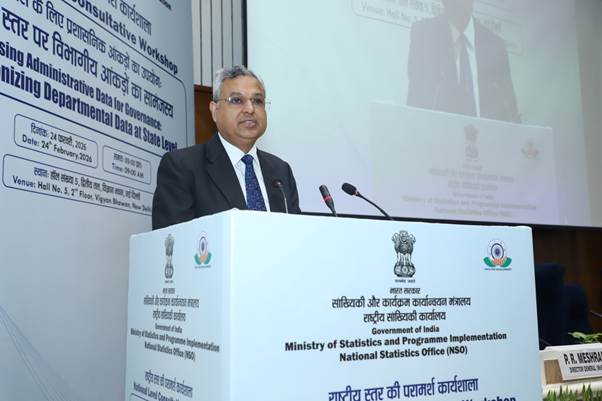
In his welcome address, Shri P. R. Meshram, Director General (Data Governance), Ministry of Statistics and Programme Implementation, emphasised that administrative data must be treated as a strategic national asset for evidence-based governance and highlighted the need to move from siloed datasets to a harmonised, interoperable, and securely linked data ecosystem.
During the day-long workshop, four thematic sessions were conducted around the central theme of using administrative data for Governance. Distinguished speakers from institutions including CEGIS, Ek Step, Microsoft, Bharat Digital and Senior Officers from States such as Karnataka, Odisha, Tamil Nadu, Rajasthan made presentations on the effective use of routine administrative data for generating policy insights. They highlighted common challenges in data reuse and integration, particularly issues related to data quality, and examined institutional architectures required to support data integration.
Operationalising the data linkage for specific purposes following the legal and governance dimensions of data management was discussed in the workshop. Foundational building blocks needed to create AI-ready and accessible data ecosystems was also deliberated upon. Emphasis was placed on the making data linkable by design, using uniform standards and identifiers.
The workshop aimed to build a shared understanding and practical roadmap for systematically harmonizing and linking administrative datasets across States and Union Territories. It concluded with defined timelines leading to the April 2026 National Summit. The deliberations reaffirmed a collective commitment to creating interoperable, AI-ready, and linkable-by-design data systems to strengthen evidence-based governance.