SARAS Aajeevika Mela 2026
SARAS Aajeevika Mela 2026
The winter sun had just begun to soften over Gurugram’s glass towers when the gates of Leisure Valley Park in Sector-29 opened to a different kind of skyline, one made not of steel and glass, but of handwoven silk, bamboo craft, spices, songs, and stories. Office-goers slowed their steps, children tugged at their parents’ hands, and the familiar corporate rhythm of the cyber city gave way to the hum of folk music and the scent of freshly cooked regional food. The SARAS Aajeevika Mela, 2026, had arrived, turning the urban landscape into a living canvas of rural India. This national-level fair (from February 10 to 26) feels less like an exhibition and more like a journey across the country. The event brought together over 900 women entrepreneurs from 28 states, representing Self-Help Groups (SHGs).
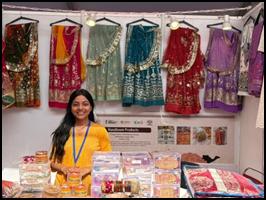
With more than 450 stalls organised across state pavilions, the mela is described as a “Mini India” that presents region-specific products rooted in local traditions and artisanal skills. Visitors encountered Pashmina shawls from Kashmir, silk textiles from Tamil Nadu, embroidered poshaks from Rajasthan, and bamboo crafts from Assam, alongside regional foods, handicrafts, and cultural performances. Beyond its cultural vibrancy, the mela illustrates a structured market linkage model within livelihood promotion frameworks. It demonstrates how curated urban exhibitions can enhance income opportunities, enable direct-to-consumer sales, strengthen brand visibility for SHG products, and promote women-led micro-enterprises within a formalised marketplace.
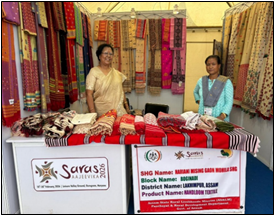
Beyond the visual appeal of crafts and textiles, the mela foregrounds narratives of institutional support and socio-economic transformation. At one stall, the distinctive golden hue of Assam’s Muga silk immediately draws attention. A Geographical Indication (GI)-recognised product, Muga silk is uniquely produced in Assam and represents a long-standing handloom tradition. Najitra Didi manages the stall from Lakhimpur district, representing the Hariyani Mising Gaon Mohila SHG. Since 1984, she has trained over 25,000 women and supported them in obtaining artisan cards and formal market linkages. She has played a catalytic role in training rural women artisans, equipping them not only with weaving skills but also with knowledge of pricing strategies, consumer preferences, and market dynamics. Many of the artisans she mentors have limited mobility and limited linguistic exposure beyond their villages. Therefore, by accompanying them, she is facilitating communication, negotiation, and market access.
Displaying handwoven Muga silk sarees priced between ₹30,000 and ₹70,000, she notes a significant shift in consumer demand towards authentic handloom products over machine-made alternatives. Within the initial days of the mela, her stall recorded sales exceeding ₹3 lakh. The Muga silk on display thus represents not merely a textile product, but the cumulative outcome of mentorship, collective organisation, and the revitalisation of traditional craft economies.
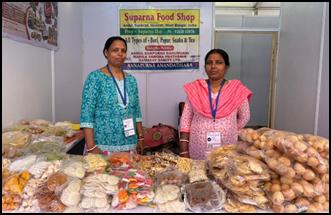
A few rows away, a steady stream of visitors gathers around a food stall managed by Suparna Didi from West Bengal, drawn by the aroma of freshly prepared traditional snacks. Formerly managing household responsibilities while supplementing income through irregular insurance work, she sought greater financial stability and autonomy. In 2011, she mobilised ten women to form a Self-Help Group (SHG), initiating small-scale production of papads and regional food items within home-based kitchens.
Over time, her enterprise expanded, and she now coordinates multiple SHGs within her gram panchayat. In just a week at the fair, she has sold goods worth over ₹50,000, with profit margins of 60–70 percent over production cost. The production model remains decentralised; women prepare goods at home, which are subsequently aggregated, packaged, and marketed collectively. This system has been strengthened through capacity-building and financial support from the District Rural Development Cell. Participation in exhibitions across Delhi, Noida, Punjab, and Darjeeling has enabled average earnings of approximately ₹1 lakh per event.
However, the transformation extends beyond income generation. SHG meetings function as spaces of mutual support, where women deliberate on household concerns, social constraints, and personal aspirations. Suparna Didi also highlights her daughter’s growing success in pottery, with products showcased at domestic and international fairs. What began as an effort toward financial independence has evolved into a broader process of intergenerational empowerment, illustrating how collective enterprise can reshape social and economic trajectories for rural women and their families.
At another stall, jute mats, wooden kitchen implements, and handcrafted items are systematically displayed under the stewardship of Shobhita Didi from West Bengal. She initiated her Self-Help Group (SHG) in 2006 with ten members and has since expanded her leadership to encompass 374 SHGs across the district. Her entrepreneurial trajectory was catalysed by training received under the Deendayal Antyodaya Yojana–National Rural Livelihoods Mission (DAY-NRLM), through which she developed technical proficiency in jute craftsmanship.
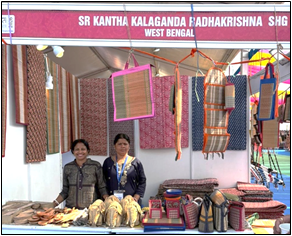
Subsequently, she established a production workshop employing local women artisans and sourcing raw jute directly from nearby farmers, thereby fostering an integrated local demand-and-supply chain that reinforces rural economic linkages. In 2023, she diversified into wood-based handicrafts, producing functional household items, including combs and kitchen tools. Access to institutional credit and government subsidies facilitated business expansion, while digital payment systems, including UPI, streamlined financial transactions. In addition to participating in government-organised fairs, she collaborates with non-government organizations that distribute her products in urban markets such as Jaipur and Delhi. Her progression illustrates the evolution of skill-based training into a decentralised rural enterprise ecosystem anchored in collective production, local value chains, and digital financial inclusion.
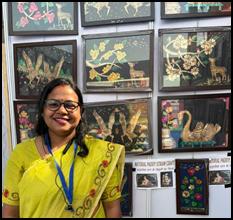
Adjacent to the demonstration area, visitors assemble around a display where intricate motifs are crafted from golden rice straw. Jyotsna Didi from Hooghly, West Bengal, is recognised as India’s first woman practitioner of natural paddy straw painting. After joining a Self-Help Group (SHG) in 2013 and receiving formal handicraft training, she began experimenting with rice-straw art in 2015. She now trains and engages 15–16 women artisans who produce detailed designs from their homes, which she aggregates and markets at exhibitions nationwide. Her enterprise exemplifies the transformation of agricultural residue into value-added artistic products, illustrating how innovation can emerge from the creative reinterpretation of existing resources.
The mela’s demonstration and live learning zone further reinforces this ethos of skill visibility and knowledge transmission. Visitors, including children, observe potters shaping clay, artisans practising mirror embroidery, and bamboo weavers at work. By foregrounding the production process alongside the finished goods, the fair underscores the labour, craftsmanship, and cultural heritage embedded in each product.
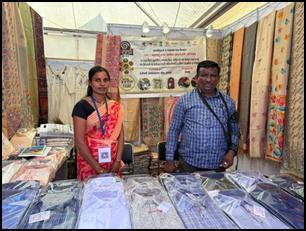
Within the Maharashtra pavilion, members of the Sanjeevani Mahila SHG from Nagpur showcase cotton shirts and sarees manufactured in their rural production unit. What originated as small-scale tailoring has evolved into a structured enterprise employing over 30 women. With institutional support from the Maharashtra State Rural Livelihood Mission (MSRLM) and the local administration, the group received skill training, access to machinery, and market facilitation. The initiative has provided stable employment to economically vulnerable women.
The enterprise sources cotton from local farms practising mixed cropping, thereby integrating primary agriculture with value addition at the village level. Cotton shirts are priced at approximately ₹600, while sarees range between ₹2,000 and ₹5,000. Participation in exhibitions across major cities can yield seasonal revenues of ₹8-9 lakh. For members, empowerment manifests in tangible terms: regular income, collective enterprise management, technical proficiency with modern machinery, and enhanced confidence derived from formal production and market engagement.
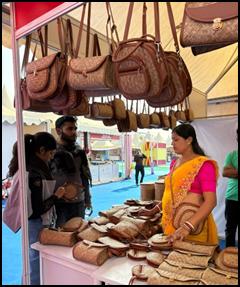
Another pavilion from Assam features meticulously crafted bamboo bags that reflect both traditional skill and contemporary design sensibilities. Vishakha Didi, who joined a Self-Help Group (SHG) in 2014, revitalised her father-in-law’s bamboo craft enterprise by introducing product innovations and leveraging expanded market access. With government financial assistance and exposure through exhibitions, including participation in the India International Trade Fair 2025 in Delhi, she scaled her business to achieve sales exceeding ₹2 lakh. Her trajectory illustrates how education, institutional facilitation, and market linkages can modernise inherited crafts and transform them into viable, growth-oriented enterprises.
Beyond its commercial dimension, the SARAS Mela functions as a structured capacity-building platform. At the Knowledge and Learning Pavilion, women participate in workshops on packaging, branding, proposal development, and digital marketing strategies. Dedicated sessions on logistics and transportation management equip them with the skills to distribute products efficiently across domestic and international markets. Collaborations with e-commerce platforms and awareness initiatives around the E-SARAS portal are designed to extend market access beyond the fair’s duration, ensuring continuity in sales and enterprise sustainability.
As evening descends and the mela lights illuminate the park, the fair emerges as a microcosm of rural enterprise and collective aspiration. Visitors depart with handloom textiles, crafts, and regional foods, and with inspiring stories of mentorship, entrepreneurship, and community-driven innovation rooted in tradition and shared prosperity. In a fast-paced urban setting, the SARAS Aajeevika Mela creates space to recognise the labour, resilience, and livelihoods embedded in each stall.
Reference
Ministry of Rural Development
https://www.pib.gov.in/PressReleseDetailm.aspx?PRID=2225912®=3&lang=2