Global Tech Leaders Outline a Democratic, Inclusive AI Future in India AI Impact Summit 2026
Global Tech Leaders Outline a Democratic, Inclusive AI Future in India AI Impact Summit 2026
As part of the India AI Impact Summit 2026, keynote addresses by Sam Altman, CEO, OpenAI; Brad Smith, Vice Chair & President, Microsoft; Ankur Vora, President, Africa and India Offices, Gates Foundation; and Julie Sweet, Chair & CEO, Accenture, underscored the transformative potential of artificial intelligence while emphasizing democratization, inclusion, global standards and human-led reinvention. The India AI summit was inaugurated today by Prime Minister Sh Narendra Modi where he said that AI must become a tool for inclusion and empowerment, particularly for the Global South.
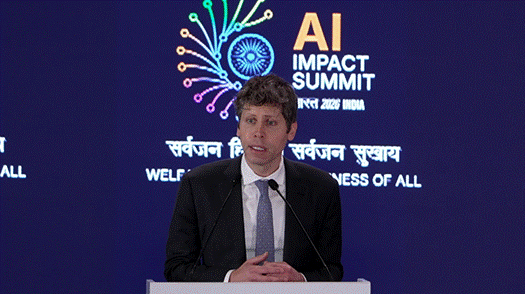
Sam Altman, CEO, OpenAI, highlighted both the extraordinary pace of technological advancement and India’s growing role in shaping its trajectory, stating, “On our current trajectory, we believe we may be only a couple of years away from early versions of true super intelligence. If we are right, by the end of 2028, more of the world’s intellectual capacity could reside inside of data centers than outside of it.” Stressing the importance of openness and societal resilience, he added, “Democratization of AI is the only fair and safe path forward. Democratization of AI is the best way to ensure that humanity flourishes.”
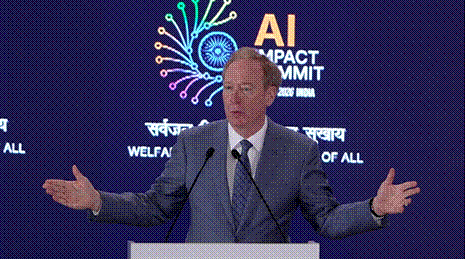
Brad Smith, Vice Chair & President, Microsoft, framed AI as a decisive force in addressing the global technology divide, noting, “AI, perhaps more than any other technology this century, will play a decisive role in either closing this economic divide or exacerbating it. That is the single most important question for us today: How can we do better?” He emphasized infrastructure, skilling and linguistic diversity as essential to ensuring that AI serves the Global South and translates into broad-based prosperity.
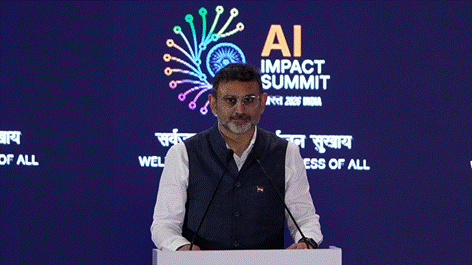
Ankur Vora, President, Africa and India Offices, Gates Foundation, focused on AI’s potential to accelerate health, education and agricultural outcomes, asserting, “Many people predict that AI will help the world be better for everyone. Others predict it will only benefit the privileged few. But the fact is, it’s not a matter of prediction. It’s a choice.” Announcing new philanthropic initiatives, he underscored that the true measure of AI will be whether it tangibly improves lives across communities that have historically been left behind.
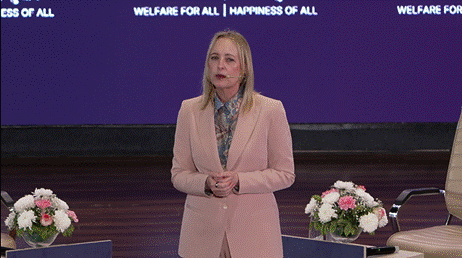
Julie Sweet, Chair & CEO, Accenture, called for reinvention across companies, governments and individuals, stating, “Using AI as an engine for growth is the only path for global prosperity, for all.” She emphasized that sustainable progress will require leadership, global standards, workforce transformation and a commitment to ensuring that AI drives growth while keeping humans firmly in the lead.
Collectively, the four keynote addresses captured the defining tension of the AI moment: unprecedented technological acceleration alongside an urgent need for responsibility, inclusion and global cooperation. From superintelligence and sovereign capability to infrastructure, skilling and social impact, the leaders converged on a shared imperative, that AI must not deepen divides, but close them; must not concentrate power, but expand opportunity; and must ultimately be shaped by human values, democratic institutions and purposeful leadership.