Union Minister Shri Rajiv Ranjan Singh to launch Access pass for Fishing in Economic Exclusive Zone (EEZ) at Veraval, Gujarat
Union Minister Shri Rajiv Ranjan Singh to launch Access pass for Fishing in Economic Exclusive Zone (EEZ) at Veraval, Gujarat
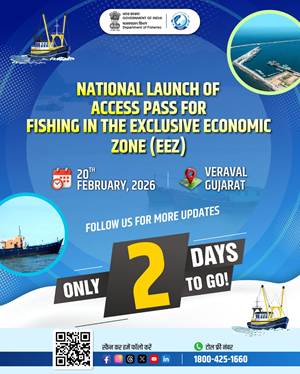
Hon’ble Union Minister, Shri Rajiv Ranjan Singh Alias Lalan Singh, Ministry of Fisheries, Animal Husbandry & Dairying (MoFAH&D) and Panchayati Raj to launch Access pass for fishing in EEZ on 20th February 2026 at Veraval, Gujarat.
India is endowed with a vast and diverse marine resource base, supported by a coastline of approximately 11,099 km and an Exclusive Economic Zone (EEZ) of about 24 lakh square kilometres. This extensive maritime domain constitutes a significant component of India’s natural capital and offers immense potential for sustainable fisheries development, livelihood generation, food security and export growth. India presently ranks as the second-largest producer of fisheries and aquaculture globally, and exported seafood valued at around ₹62,408 crore during FY 2024-25.
Most fishing activity remains limited to 40–50 nautical miles from the coastline, while the vast EEZ, extending from 12 to 200 nautical miles, remains underutilised despite significant potential, particularly for high-value species such as tuna.
To harness the untapped potential, in pursuance of the Union Budget announcement 2025-26 and to provide a robust legal and institutional framework for fisheries in the EEZ, Government of India has notified the Rules for “Sustainable Harnessing of Fisheries in the Exclusive Economic Zone (EEZ), 2025” under the Territorial Waters, Continental Shelf, Exclusive Economic Zone and Other Maritime Zones Act, 1976 (Act 80 of 1976) on 4th November 2025 to promote responsible and sustainable utilisation of marine fisheries resources in the Indian EEZ. In addition, a National Framework on traceability in fisheries and Aquaculture has been developed.
These measures strengthen monitoring, compliance and safety of fishing operations, while improving the livelihoods of marine fishing communities, with a special focus on empowering traditional and small-scale fishers, fisheries cooperatives, Self Help Groups and FFPOs to participate in deep-sea fishing fish processing, value addition and allied activities, thereby supporting growth of seafood exports. In this direction, a Joint Working Group (JWG) has been constituted by the Department of Fisheries with Ministry of Cooperation to further strengthen fisheries cooperatives in deep sea fishing and its entire value chain including processing, value addition, marketing and exports.
Furthermore, the Department of Fisheries, Government of India, has envisaged a strategic focus on the development of 34 fisheries production and processing clusters across key regions of the country, including the Fishing Harbour Cluster at Veraval, Gujarat, given its prominence as a major processing and export hub.
India’s fisheries and aquaculture sector is entering a new era of transformation, driven by a strong governmental thrust on export competitiveness, digital integration, and sustainable growth. A key priority of the Government is to enhance value addition and ensure end‑to‑end traceability across the seafood value chain. The integration of digital platforms with catch certification, health certification and modern processing infrastructure is strengthening quality assurance and compliance with international standards. These efforts are expected to unlock access to premium global markets, improve value realisation, and ensure that the gains from India’s seafood exports accrue directly to fishers and coastal communities.
A central feature of the EEZ Rules is the introduction of a transparent and legally backed Access Pass Framework for authorised fishing operations in the EEZ. This framework and Access Pass will empower Indian fishers to access high-value resources, meet export standards such as traceability, certification and significantly enhance their income across the fisheries value chain.
The launch represents a decisive step towards operationalizing a transparent, sustainable and fisher-centric governance framework for offshore fisheries in the EEZ of India. It symbolizes India’s transition from nearshore-dependent fishing towards a sustainable and future-ready offshore fisheries regime, aimed at unlocking the untapped potential of deep-sea resources, enhancing fishers’ incomes, strengthening seafood exports and advancing the national vision of a prosperous and inclusive Blue Economy.