NSSTA Celebrates 18th Foundation Day
NSSTA Celebrates 18th Foundation Day
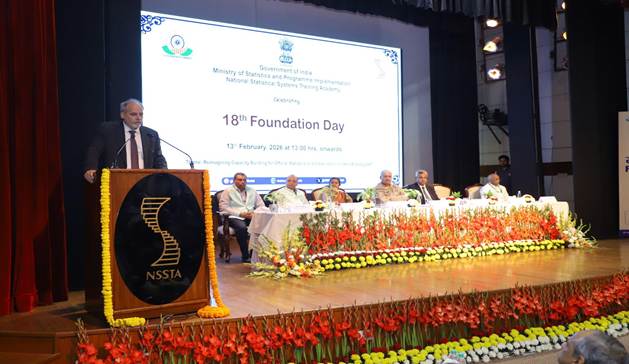
The National Statistical Systems Training Academy (NSSTA), Ministry of Statistics &Programme Implementation, Government of India celebrated its 18th Foundation Day at Mahalanobis Auditorium, NSSTA, Knowledge Park-II, Greater Noida, Uttar Pradesh. The theme for this year’s celebration was “Reimagining Capacity Building for Official Statistics to achieve vision of Viksit Bharat@2047”. The occasion marked NSSTA’s journey as a premier Central Training Institute and its continuing role in strengthening India’s Official statistical system by nurturing a skilled, ethical and future-ready statistical workforce, and by promoting quality, timeliness and credibility of official statistics.
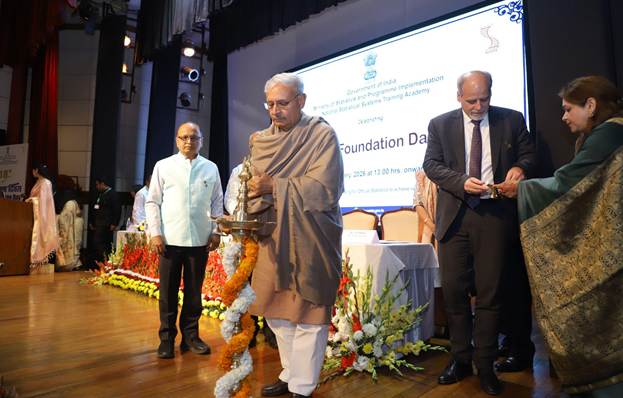
The celebration commenced with the lighting of the lamp by dignitaries, followed by Vandana. ShriP. R. Meshram, ISS, Director General (Data Governance), MoSPI delivered the welcome address and reflected on NSSTA’s transformative journey as a cornerstone of India’s statistical framework.
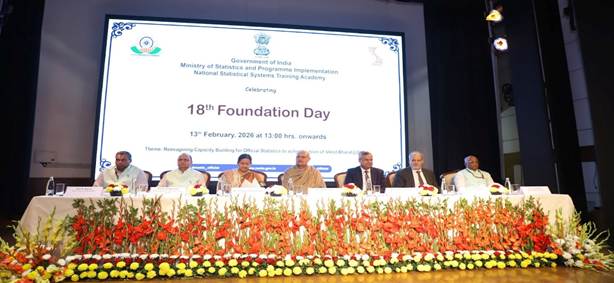
He emphasized that capacity building in statistics today is no longer confined to traditional training modules. The capacity building is about investing in people, processes and platforms today, so that the official statistics become a strategic enabler of inclusive, sustainable and globally competitive development for tomorrow. Addressing the ISS probationers, he stated that they represented the future of India’s statistical leadership and responsibility of translating data into development outcomes rests significantly on their shoulders. He underscored the importance of effective communicating strategies as it is essential to make people understand statistics in right perspective.
The Union Minister, Rao Inderjit Singh, Union MOS (I/C), M/o S&PI, MOS (I/C), M/o Planning and MOS, M/o Culture, while marking a key milestone in the journey of the National Statistical Systems Training Academy (NSSTA) and acknowledging the pillars who have supported its growth, underscored that statistics is the bedrock of evidence-based governance. In a country as diverse as India, he noted, statistics is essential to understanding and addressing the varied needs of citizens, and NSSTA plays a vital role by building a skilled, future-ready pool of statistical personnel for the nation. He added that this initiative is part of a larger reimagining of capacity building, anchored in inclusion, sustainable growth and skilled leadership to ensure the effective implementation and use of statistical data
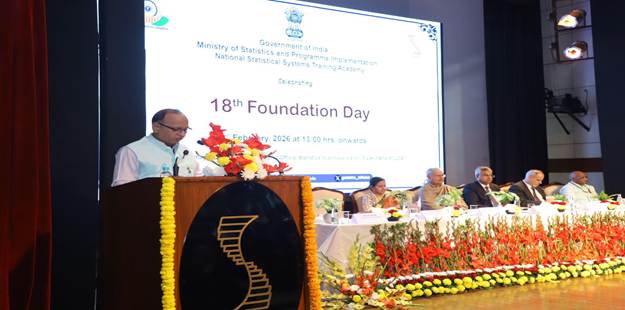
Aligning with the national philosophy of SabkaSaath, Sabka Vikas, Sabka Vishwas and SabkaPrayas, the Minister said capacity building must move beyond traditional methods and adopt technology-driven systems, including the use of Big Data, Artificial Intelligence and Machine Learning to improve the accuracy, timeliness and global comparability of official statistics. He encouraged NSSTA to deepen engagement with State statistical systems and expand partnerships with universities and specialised institutes, reaffirming MoSPI’s commitment under Mission Karmayogi to strengthen training programmes and build a future-ready statistical workforce. He also lauded NSSTA’s international training outreach and reiterated that investing in official statistics strengthens governance and improves public service delivery. He emphasized that, Strong nations rise from strong institutions, and strong institutions are build by capable people; thus investing in capacity for official statistics is investment in better governance, better policies, and better future for our citizens.
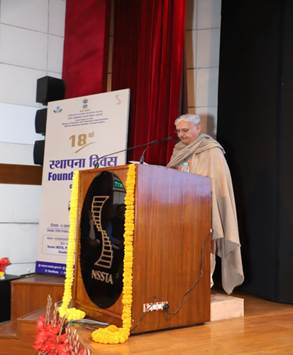
Dr. Saurabh Garg, IAS, Secretary, MoSPI,on the occasion of the Foundation Day of the National Statistical Systems Training Academy (NSSTA), highlighted the transformative role of data as the “fifth factor of production,” alongside land, labor, capital, and technology, noting its recognition as a strategic asset in the System of National Accounts and its critical function as the raw material for Artificial Intelligence. To harness this potential, the Secretary detailed the Cabinet’s restructuring of the Indian Statistical Service (ISS), which now deploys officers across 60 ministries to ensure data harmonization, machine-readability, and seamless integration into high-level decision-making.
This shift aligns with the Prime Minister’s vision for data-driven governance and the outcomes of the Chief Secretaries’ Conference, which identified improving data usage and access at both the Central and State Governments level, for better decision making. Moving forward, the Secretary emphasized that the Ministry’s mandate is evolving from producing macro-level aggregates toward granular, district-level data dissemination, ensuring that precise information drives effective policy implementation and fulfills the nation’s strategic development goals.
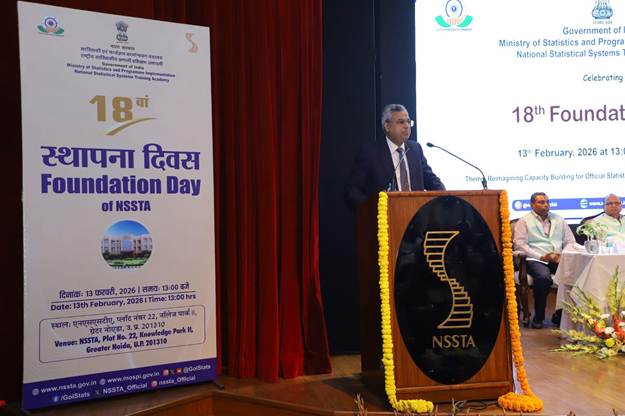
Ms. S. Radha Chauhan, IAS, Chairperson, Capacity Building Commission (CBC) emphasized that the statistical community must urgently scale human capacities to match the rapid evolution of Artificial Intelligence. Highlighting the shift toward Agentic AIwhere AI agents function as autonomous powers rather than passive toolsthe Chairman called for a multifold expansion of NSSTA’s training to prepare officers for a future where technology-driven systems must be managed with sophisticated expertise. A critical focus was placed on the necessity of human intervention to provide context to raw data and mitigate the risks of inherent biases in AI, which can have profound societal impacts if left unchecked. Ultimately, the Chairman asserted that capacity building must be a continuous mission to ensure that statistical officers are polished and trained to deliver high-quality, unbiased data, thereby safeguarding the integrity of the nation’s governance in the lead-up to the upcoming AI Summit and beyond.
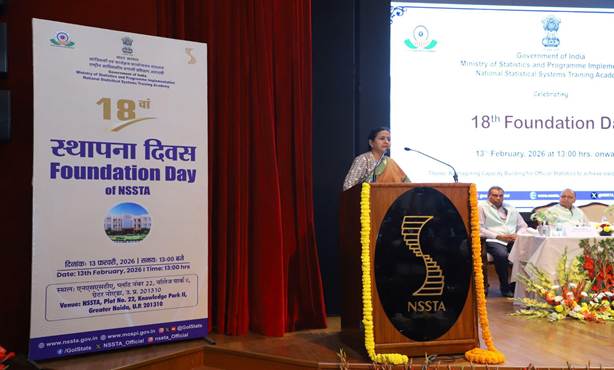
Mr. Stefan Priesner, United Nations Resident Commissioner (UNRC), lauded the National Statistical Systems Training Academy (NSSTA) on its Foundation Day, describing statistics as the “grammar of development” essential for achieving both the UN Sustainable Development Goals 2030 and India’s Vision 2047. He emphasized that accurate measurement is the bedrock of institutional accountability, ensuring public resources reach those left behind. Praising India’s leadershipfrom the legacy of P.C. Mahalanobis to modern milestones like the first comprehensive income survey and the integration of GST data at the village levelhe highlighted the nation’s successful adoption of AI, Machine Learning, and satellite imagery. He emphasized that accurate measurement is the bedrock of institutional accountability, ensuring public resources reach those left behind. Praising India’s leadershipfrom the legacy of P.C. Mahalanobis to modern milestones like the first comprehensive income survey and the integration of GST data at the village level. Looking toward 2047, Mr. Priesner reaffirmed the UN’s commitment to a reciprocal partnership, noting that India’s innovative statistical architecture is poised to become a powerful global model for data-driven governance and leadership.
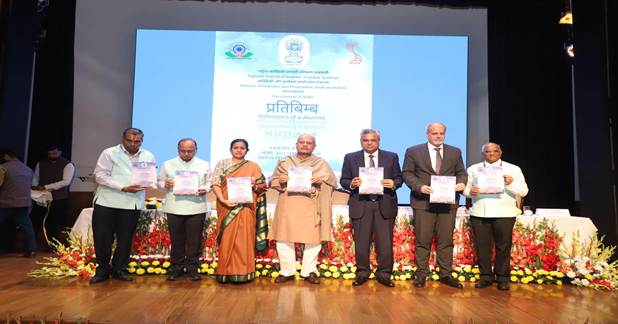
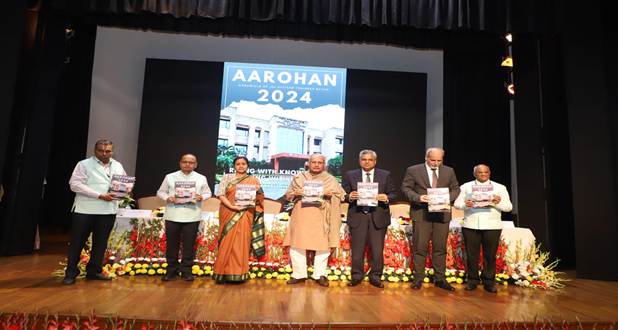
As part of the celebrations, NSSTA released two journals, “AAROHAN” and “PRATIBIMB”prepared by the Officer Trainees of ISS 2024 and 2025 batches, respectively. The journals capture reflections on their training journey and learning experiences during probation, including academic and field exposures, and highlight how these experiences are shaping their readiness to contribute meaningfully to the official statistical system. The Union Minister also presented Certificates of Appreciation to top performers of the Ministry in the iGOT Karmayogi courses.
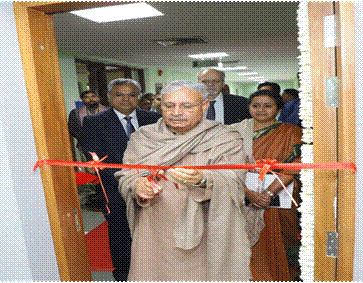
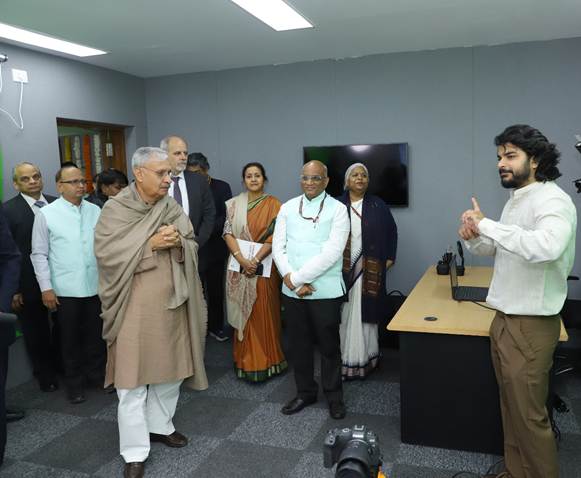
On the occasion, Union Minister MoSPI inaugurated the Digital Data Lab, as a major milestone in strengthening digital capacity building and technology-enabled learning within the statistical system. Envisioned as a modern, technology-driven learning space, the Lab will promote digital skilling, immersive training, and hands-on exposure to emerging tools, while serving as a hub for data analytics, digital governance, e-learning ecosystems, and competency-based training aligned with the vision of Mission Karmayogi.
This was followed by a Panel Discussion on “Communicating Statistics to the Policymakers and Public”. The panelists included Ms. Puja Singh Mandol, IA & AS, Addl. Secretary, MoSPI; Dr. Abhishek Jain, IAS, Secretary, Finance and Economics, Statistics, Government of Himachal Pradesh; Ms. Maaike Bijker, Chief of Evidence for Children, UNICEF India; and Dr. Rajesh Shukla, Managing Director and CEO, People Research on India’s Consumer Economy. The session was moderated by Dr. T. C. A. Anant, Former CSI & Secretary, MoSPI. The panel moved beyond the technicalities of data collection to address the real-world challenge of ensuring that national statistics actually reach and influence the people they are meant to serve. The experts collectively argued that for statistics to be truly powerful, they must be transformed into easily understandable which help leaders make quick, informed decisions and help the public understand the progress of their country.
The event featured an enriching exchange where seasoned officers from the ISS 2010 and 2011 cohorts shared first-hand insights from their distinguished career. Their reflections on past experiences, combined with a forward-looking perspective on theevolution of national statistics, served to inspire and guide the newest batches ofofficers as they begin their own professional journeys in official statistics.
Today’s NSSTA 18th Foundation Day celebration reaffirmed NSSTA’s commitment to nurturing a future-ready statistical workforce aligned with the vision of Viksit Bharat@2047.