Union Budget 2026-27: Rural Transformation through Decentralization
Union Budget 2026-27: Rural Transformation through Decentralization
Key Takeaways
Introduction
India’s pursuit of inclusive growth under the development framework of Sabka Saath, Sabka Vikas, Sabka Prayas, Sabka Vishwas has produced measurable outcomes in recent years. These outcomes are reflected in sustained poverty reduction, a gradual narrowing of socio-economic inequalities, and improved access to basic services. Rural transformation has been central to this process, as a large share of India’s population continues to reside in rural areas and remains dependent on public investment, local institutions, and community-based governance structures for socio-economic advancement.
A combination of expanded public expenditure, infrastructure development, reforms to employment frameworks, the adoption of digital technologies, and stronger participation by local governments and community institutions has increasingly shaped rural development in India. This paradigmatic shift reflects a broader understanding of inclusive development that emphasises fairness, dignity, and equal rights, with a particular focus on empowering vulnerable and marginalised groups.
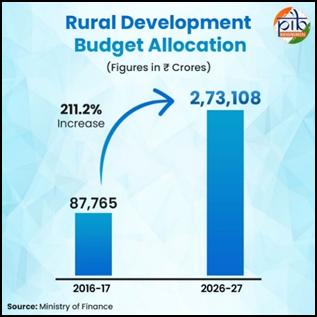
Union Budget allocations for Rural Development increased from ₹87,765 crore in 2016–17 to ₹2,73,108 crore in 2026–27, representing a rise of over 211 per cent during the decade. These figures indicate a sustained fiscal commitment to strengthening rural infrastructure, livelihoods, and local institutional capacity.
Policy Shift: From Welfare Delivery to Decentralised Partnerships
An essential dimension of this transformation is the gradual shift away from a purely government-led model of development towards more community-driven, decentralised approaches. Local governments and grassroots institutions are increasingly recognised as critical actors in planning, implementation, and monitoring of development initiatives. This transition has enabled local voices to shape development priorities, making growth processes more participatory, context-specific, and sustainable.
The 73rd Constitutional Amendment (1992) institutionalised Panchayati Raj Institutions (PRIs) as vehicles of grassroots democracy, enabling communities to participate directly in the planning, implementation, and monitoring of development initiatives. Building on this foundation, major national programmes such as the Viksit Bharat-Guarantee for Rozgar and Ajeevika Mission (Gramin), formerly MGNREGS, Deendayal Antyodaya Yojana-National Rural Livelihoods Mission, Swachh Bharat Mission, and the Jal Jeevan Mission have embedded participatory mechanisms by working through panchayats, self-help groups (SHGs), and grassroots organisations.
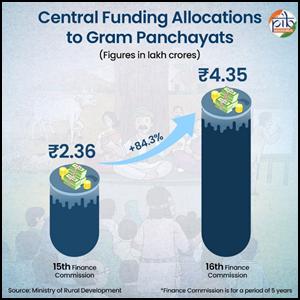
This policy evolution reflects the principle of Jan Bhagidari, which marks a shift from beneficiary-based participation to active partnership between the state and communities. Participation is increasingly supported through capacity building, technology-enabled engagement, strengthened community institutions, and participatory planning and budgeting processes. Fiscal decentralisation has further reinforced this approach. Direct fiscal transfers to panchayats have been increased from around ₹2.36 lakh crore under the 15th Finance Commission (2021-2026) to nearly ₹4.35 lakh crore under the 16th Finance Commission (2026-2031), thereby significantly enhancing local financial autonomy.
Social Protection Expansion and Poverty Reduction Outcomes in India
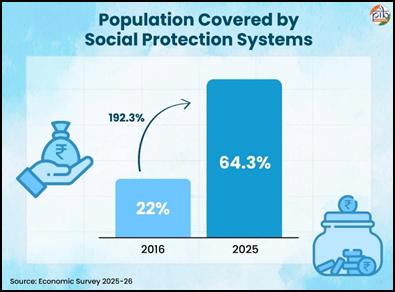
India has recorded substantial advances in expanding social protection and reducing poverty, underpinned by sustained public investments in the social sector. Coverage under social protection systems (which includes access to improved drinking water, household electrification, and rural sanitation) increased markedly from 22 percent in 2016 to 64.3 percent in 2025, reflecting a significant broadening of social security reach. This expansion has been supported by a steady rise in social services expenditure (SSE), which has grown consistently since FY22. Between FY22 and FY26 (BE), SSE grew at a compound annual growth rate (CAGR) of 12 percent, with education and health expenditures rising at 11 percent and 8 percent, respectively.
Assessing Poverty through Multi-Dimensional Indicators
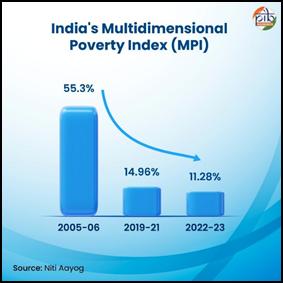
India’s Multidimensional Poverty Index (MPI), published by NITI Aayog, indicates Poverty Headcount Ratio declined from 55.3 per cent in 2005–06 to 14.96 percent in 2019–21 and further to 11.28 percent in 2022–23. Estimates based on the Tendulkar Committee methodology similarly indicate a pronounced reduction in poverty over time. Between 2011–12 and 2023–24, poverty incidence is estimated to have declined sharply, with low levels observed across both rural and urban areas and across states. Taken together, these trends suggest that sustained economic growth, in conjunction with targeted social welfare interventions and expanded access to basic services, has contributed to a significant reduction in poverty in India. This progress reflects the combined efforts of central and state governments through a range of welfare programmes and context-specific policy innovations.
Enhancing Rural Living Standards through Basic Services
Public policy in India is oriented towards expanding equal opportunity, reducing absolute poverty, and mitigating the risk of widening inequality. Government initiatives have focused on expanding access to affordable housing, food and social security, financial inclusion, universal basic services, and affordable healthcare. Together, these interventions have played a central role in improving living standards, particularly in rural areas. The scale and outcomes of these interventions are reflected in the Ministry of Statistics and Programme Implementation’s (MOSPI’s) Sustainable Development Goal (SDG) National Indicator Framework Progress Report, 2025, which documents substantial advances across multiple development indicators.
Accessibility to Safe Drinking Water
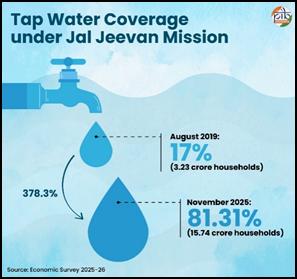
Access to safe drinking water in rural areas has reached near-universal coverage. It has seen transformative progress under the Jal Jeevan Mission (JJM), launched in 2019 to achieve Har Ghar Jal. At inception, only 3.23 crore rural households (17 per cent) had tap water connections. By November 2025, an additional 12.50 crore households were covered, raising total coverage to about 15.74 crore households. Therefore, the proportion of rural households using improved drinking water sources increased from 94.6 per cent in 2015–16 to 99.6 percent in 2024–25. The Economic Survey 2025–26 reports that independent assessments have identified significant social and health benefits, including substantial time savings for women, increased participation in economic activities, and reduced incidence of waterborne diseases. Significant improvements in sanitation and electricity access have further complemented these gains.
Accessibility to Sanitation Facilities
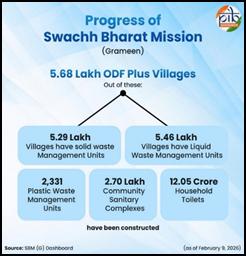
The Swachh Bharat Mission (Grameen) was launched in 2014 to achieve Open Defecation Free (ODF) status nationwide by October 2019, and all districts were declared ODF by 2019–20. As of December 31, 2025, over 96 percent of villages under the Swachh Bharat Mission have attained ODF Plus status. An ODF Plus village is defined as one that sustains its ODF Status, ensures solid and liquid waste management, and remains visually clean. As of February 9, 2026, there are 5.68 lakh ODF Plus villages in our country, of which 5.29 lakh have suitable arrangements for solid waste management and 5.46 lakh have suitable arrangements for liquid waste management. So far, 2,331 plastic waste management units, 2.70 lakh community sanitary complexes, and 12.05 crore household toilets have been constructed.
Ensuring Universal Household Electrification
Pradhan Mantri Sahaj Bijli Har Ghar Yojana (SAUBHAGYA) was launched in 2017 to achieve universal household electrification by providing electricity connections to all willing un-electrified households in rural areas and all willing poor households in urban areas in the country. In 2017, the total number of un-electrified households was estimated at 3 crores, against which 2.86 crore households across the country were electrified by FY 2021-22. As of March 31, 2019, all States have reported 100% electrification of all the willing un-electrified households identified.
Expanding Access to Safe and Affordable Rural Housing
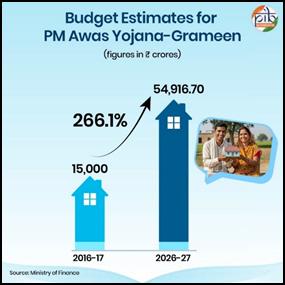
Housing constitutes a critical determinant of dignity, safety, and economic participation among low-income households. Implemented since April 2016, the Pradhan Mantri Awaas Yojana-Gramin (PMAY-G) aims to achieve the objective of Housing for All by 2029 by providing pucca dwellings with basic amenities to eligible rural households. Against an overall target of 4.95 crore houses, 4.14 crore units have been allocated to States and Union Territories, of which 3.86 crore have been sanctioned and 2.93 crore completed to date. In addition, 76.98 lakh dwelling units pending from earlier housing schemes have been completed, bringing the total number of rural houses constructed over the past 11 years to 3.70 crore. Reflecting the heightened policy emphasis on rural housing, budgetary allocations for PMAY-G increased from ₹15,000 crore in 2016–17 to ₹54,916.70 crore in 2026-27.
Ensuring Last-Mile Access through Rural Roads Connectivity
Rural connectivity is a foundational pillar of rural development, directly contributing to poverty reduction by enhancing access to healthcare, education, markets, and employment opportunities. Launched in 2000, the Pradhan Mantri Gram Sadak Yojana (PMGSY-I) was designed to provide all-weather road connectivity to eligible unconnected habitations. As of mid-January 2026, more than 99.6 percent of eligible habitations had been connected. Under PMGSY-I, a total of 1,63,665 roads spanning 6.25 lakh kilometres, along with 7,210 bridges, have been completed.
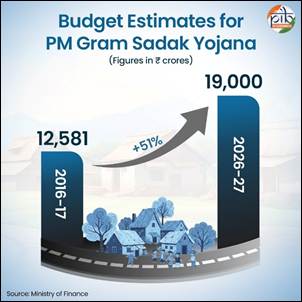
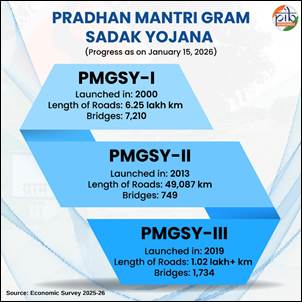
Launched in 2013, the Pradhan Mantri Gram Sadak Yojana (PMGSY-II) focused on strengthening and upgrading the existing rural road network. As of mid-January 2026, a total of 6,612 roads covering 49,087 kilometres, along with 749 bridges, had been completed under this phase. Subsequently, PMGSY-III, approved in 2019, aims at consolidating 1.25 lakh kilometres of critical rural routes linking habitations to agricultural markets, educational institutions, and healthcare facilities. Under PMGSY-III, more than 1.02 lakh kilometres of roads and 1,734 bridges have been completed to date. Reflecting sustained policy emphasis on rural connectivity, budgetary allocations for PMGSY increased from ₹12,581 crore in 2016-17 to ₹19,000 crore in 2026–27.
Improving Access to Services and Inclusion for Tribal and Vulnerable Communities
Targeted infrastructure interventions have increasingly prioritised tribal and particularly vulnerable communities. Under the PM-Janjati Adivasi Nyaya Maha Abhiyan (PM-JANMAN), which seeks to achieve saturation of government schemes across 28,700 habitations of Particularly Vulnerable Tribal Groups (PVTGs), a total of 2,495 roads spanning 7,324 kilometres and 164 bridges have been sanctioned, with 263 roads completed as of January 15, 2026. Complementing these efforts, the Dharti Abha–Janjatiya Gram Utkarsh Abhiyan (DA-JGUA) covers more than 63,000 tribal villages and focuses on enhancing access to drinking water, housing, education, healthcare, and livelihood opportunities.
Environmental sustainability and livelihood-linked infrastructure are further advanced through initiatives that strengthen community stewardship of natural resources. The establishment of 4,105 Van Dhan Vikas Kendras has benefited approximately 1.2 million individuals. At the same time, the implementation of the Forest Rights Act, 2006, has resulted in the distribution of over 2.5 million forest titles, thereby reinforcing community control over land and forest resources.
Digitalisation and Technology-Led Service Delivery in Rural Areas
Digitalisation has emerged as a critical enabler of inclusive and efficient service delivery in rural India. The integration of administrative reforms with technology adoption has enhanced transparency, participation, and accountability in the implementation of rural programmes, while simultaneously expanding access to public services in remote and underserved areas. Aadhaar seeding has developed rapidly, Aadhaar-based payment systems have been widely adopted, and electronic wage disbursements have become nearly universal. Programme monitoring has been strengthened through large-scale geo-tagging of assets, with a growing proportion of assets being created at the individual household level.
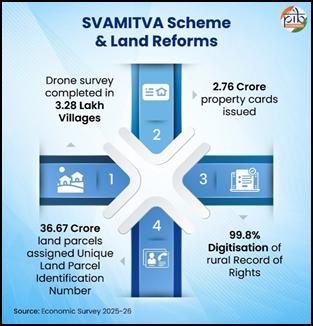
The SVAMITVA scheme uses drone-based mapping to formalise rural property rights, reduce disputes, and enhance access to credit and government services. As of December 2025, surveys covered 3.28 lakh villages and generated 2.76 crore property cards across 1.82 lakh villages. Complementing this, the Namo Drone Didi initiative supports women’s participation in the digital economy through drone-based agricultural and mapping services, with 1,094 drones distributed to SHG Drone Didis in 2023–24.
Land governance reforms under the Digital India Land Records Modernisation Programme (DILRMP) have further advanced digitisation, with 99.8 percent of rural Records of Rights digitised, 95.73 percent of Sub-Registration Offices computerised, and Unique Land Parcel Identification Numbers (ULPIN/Bhu-Aadhaar) assigned to 36.67 crore land parcels, strengthening transparency and access to land-related services.
Community-Led Institutions enabling Inclusive Governance and Livelihoods
India’s development experience highlights state capacity as a human system, in which community institutions, frontline workers, and local administrators are central to effective last-mile service delivery across health, education, skills, and livelihoods. Strengthening their capacities enhances local-level responsiveness, accountability, and the overall effectiveness of public service delivery.
Empowering Youth and Panchayats for Effective Local Governance
The Model Youth Gram Sabha (MYGS) promotes democratic engagement and civic awareness by familiarising students with grassroots governance through simulated Gram Sabha processes in schools. Implemented nationwide through institutions such as Jawahar Navodaya Vidyalayas and Eklavya Model Residential Schools, it builds leadership skills while reinforcing transparency, inclusivity, and accountability in local governance.
Complementing this, the Revamped Rashtriya Gram Swaraj Abhiyan (RGSA) strengthens decentralised governance by enhancing the institutional capacity of Panchayati Raj Institutions through leadership development, e-governance, and deeper constitutional devolution. Implemented during FY 2022–23 to 2025–26 with an outlay of ₹5,911 crore, RGSA aims to improve the efficiency and participatory quality of local governance. In the recent Union Budget 2026-27, ₹1,142 crore has been allocated for RGSA, reflecting continued emphasis on strengthening grassroots institutions.
Women-Led Institutions as Drivers of Rural Transformation
Women-led institutions are central to the Deendayal Antyodaya Yojana–National Rural Livelihoods Mission (DAY-NRLM), positioning women as key drivers of rural transformation. The programme has been allocated ₹19,200 crore in the Union Budget 2026-27. Through Self-Help Groups (SHGs) and their federations, the programme provides the rural households with a collective platform for savings, access to credit, and community support. To date, 10.05 crore women have been mobilised into 90.09 lakh SHGs, expanding financial inclusion and collective economic action.
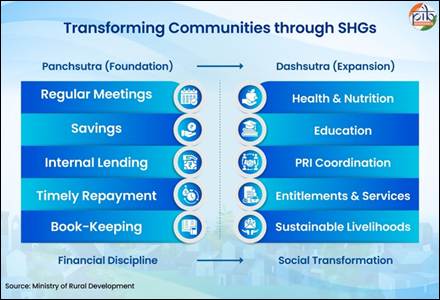
Beyond financial intermediation, the programme supports women farmers through sustainable agriculture and livestock interventions, promotes non-farm micro-enterprises, and facilitates livelihood opportunities for landless women based on local resources. Anchored in the Panchsutra and extended through the Dashsutra framework, Self-Help Groups (SHGs) increasingly contribute to community development across health and nutrition, education, local governance, access to entitlements, and sustainable livelihoods, positioning them as central institutions of community-led rural development and social transformation.
Women-Led Community Resource Pool for Livelihoods and Service Delivery
Community Resource Persons (CRPs), including Bank Sakhis, Krishi Sakhis, Pashu Sakhis, and Enterprise Promotion CRPs, facilitate the smooth functioning of women-led community institutions. These cadres strengthen women’s agency, leadership, and livelihood outcomes; currently, 1.49 lakh Bank Sakhis deliver financial services, while over 9 lakh CRPs support agriculture, banking, insurance, nutrition, and allied activities at the grassroots. Over a 6 to 8-year engagement cycle, SHG households are expected to achieve food security and stable incomes, thereby contributing to sustainable livelihood improvements.
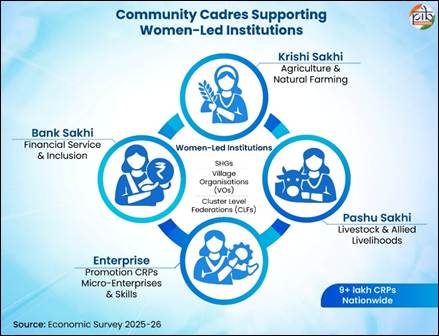
Building on this platform, the National Campaign on Entrepreneurship aims to train 50,000 CRPs and provide enterprise development support to 50 lakh SHG members under the vision of “Har Ghar Udyam, Har Gaon Samriddh.” Women-led BC Sakhis, supported by digital tools and Point of Sale (Pos) devices in collaboration with India Post, have further expanded access to banking and social security services. At the frontline, convergence between DAY-NRLM CRPs and Anganwadi Workers, ANMs, and ASHAs has strengthened SBCC-based community engagement, improving maternal and child health practices and utilisation of health services.
Samaveshi Aajeevika Yojana: Ultra-Poor Graduation Approach
The Samaveshi Aajeevika Yojana, launched in April 2023, implemented under DAY-NRLM, adopts the Ultra-Poor Graduation Approach to promote sustainable livelihoods among rural women through integrated support across livelihoods, social protection, social empowerment, and financial inclusion. State-level pilots, such as Bihar’s Satat Jeevikoparjan Yojana (SJY), demonstrate the model’s effectiveness through asset transfers, coaching, capacity building, and time-bound livelihood support, complemented by access to social security schemes and data-driven monitoring through a community-based MIS.
Community-Led Approaches to Food, Nutrition, Health, and WASH (FNHW)
India’s improvements in health and nutrition outcomes reflect the growing role of community-led delivery systems alongside national programmes. As noted in the Economic Survey 2025–26, India has outperformed global averages since 1990, with maternal mortality declining by 86 per cent, under-five mortality by 78 per cent, and neonatal mortality by 70 per cent. Infant mortality fell from 40 per thousand live births in 2013 to 25 in 2023, underscoring sustained progress in maternal and child health.
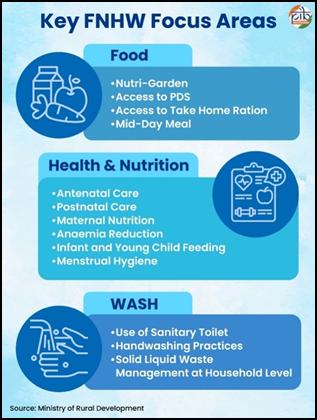
To strengthen grassroots outcomes, DAY-NRLM has institutionalized Food, Nutrition, Health, and WASH (FNHW) interventions to address persistent challenges related to malnutrition, sanitation, and health awareness. Implemented through state-specific strategies with a strong emphasis on Social and Behaviour Change Communication (SBCC), these interventions cover maternal and child health, diet diversity, anaemia reduction, menstrual hygiene, disease prevention, sanitation practices, and waste management, while promoting nutrition-sensitive livelihoods such as nutri-gardens, backyard poultry, small ruminants, and dairy. By 2025, FNHW interventions had been initiated in 6,406 blocks across 683 districts, strengthening community engagement, enhancing awareness of panchayat-level initiatives and government schemes, and supporting behavioural change toward more inclusive and participatory local governance.
Skill Development, Entrepreneurship, and Employment in Rural Areas
India’s rural labour market exhibits a distinct employment structure shaped by high dependence on agriculture and self-employment. According to the Periodic Labour Force Survey (PLFS) (October-December 2025), rural employment is dominated by agricultural workers (58.5 per cent) and self-employment (63.2 per cent), with women showing relatively higher participation in these categories. This underscores the importance of strengthening livelihoods, skills, and enterprise opportunities suited to rural contexts.
Skilling Pathways for Inclusive Rural Growth
Skill development is a critical instrument for promoting productive employment and diversifying livelihood opportunities in rural areas. The Deen Dayal Upadhyaya Grameen Kaushalya Yojana (DDU-GKY) addresses this objective through demand-driven skill training linked to assured placements, with quality and industry relevance ensured through mandatory third-party certification by National Skill Development Corporation (NSDC) Sector Skill Councils. The programme targets poor rural youth aged 15-35 years, with an extended upper age limit of 45 years for women and other vulnerable groups, including persons with disabilities, Particularly Vulnerable Tribal Groups, and transgender persons.
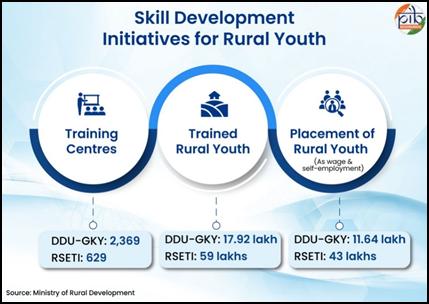
Implemented across 27 States and 4 Union Territories, DDU-GKY operates through 2,369 training centres covering 37 sectors and 816 job roles. As of October 2025, 82,272 candidates had been trained and 37,035 placed during the year, while cumulatively since inception, 17.92 lakh youth have received training and 11.64 lakh have been placed in wage employment. Complementing DDU-GKY, Rural Self Employment Training Institutes (RSETIs) function under a public–private partnership model across 629 institutes in 616 districts in 33 states/UTs, promoting both wage and self-employment through locally relevant skills and entrepreneurship training. Since its inception, RSETIs have trained nearly 59 lakh rural youth, of whom about 43 lakh have been settled in self- or wage employment, underscoring their role in strengthening rural labour market outcomes and enterprise creation.
Entrepreneurship Pathways for Women in Rural India
Promoting women’s entrepreneurship is integral to raising rural incomes and increasing female labour force participation. Aligning skill development initiatives with emerging sectors such as manufacturing, renewable energy, digital services, and agro-processing broadens economic opportunities for women. Complementary measures, including ‘Back to Work’ and ‘Returnship Programmes’, facilitate workforce re-entry. At the same time, integrating Self-Help Groups (SHGs) into the MSME ecosystem supports women’s transition from subsistence activities to formal, growth-oriented enterprises.
SHE-Marts for Rural Women-led Enterprises
Building on the success of the Lakhpati Didi Programme, the Union Budget 2026-27 proposes establishing Self-Help Entrepreneur (SHE) Marts as community-owned retail outlets within Cluster-Level Federations. Supported by enhanced, innovative financing mechanisms, these initiatives aim to shift women’s livelihoods from credit-based activities to sustainable enterprise ownership.
Advancing Employment Pathways in Rural India
The Viksit Bharat Guarantee for Rozgar and Ajeevika Mission (Gramin) Act, 2025, represents a significant reform in India’s rural employment policy. With a budgetary allocation of ₹95,692.31 crore in 2026–27, the Act modernises the employment guarantee regime by strengthening accountability mechanisms and aligning job creation with objectives of infrastructure development and climate resilience. The Act represents a substantive advancement over MGNREGA.
Conclusion
India’s rural development trajectory over the past decade indicates a structural transition from fragmented welfare provision towards an integrated, decentralised, and community-led development paradigm. Sustained public investment, evidenced by significantly enhanced budgetary allocations, has broadened access to housing, rural connectivity, drinking water, sanitation, digital services, and social protection, while concurrently strengthening livelihoods, skill formation, and entrepreneurship in rural areas. Central to this transformation has been the empowerment of local institutions, including Panchayati Raj Institutions, Self-Help Groups, and community cadres, which have reoriented rural governance from passive beneficiary models to active, participatory partnerships grounded in the principle of Jan Bhagidari. Technology-enabled service delivery, women-led institutional frameworks, and graduation-based livelihood strategies have further reinforced transparency, inclusion, and resilience, particularly among vulnerable and marginalised populations. Collectively, these reforms position rural India not merely as a recipient of development interventions but as a pivotal driver of inclusive growth, democratic governance, and long-term socio-economic sustainability.
References
Ministry of Finance
https://www.indiabudget.gov.in/doc/bh1.pdf
https://www.indiabudget.gov.in/doc/eb/stat4a.pdf
https://www.indiabudget.gov.in/economicsurvey/doc/echapter.pdf
https://www.indiabudget.gov.in/budget2016-2017/ub2016-17/bh/bh1.pdf
https://www.indiabudget.gov.in/budget2016-2017/ub2016-17/eb/sbe75.pdf
https://www.indiabudget.gov.in/doc/Budget_at_Glance/budget_at_a_glance.pdf
Ministry of Rural Development
https://lakhpatididi.gov.in/latest-updates/
https://www.pib.gov.in/PressReleasePage.aspx?PRID=2221796®=3&lang=1
https://www.pib.gov.in/PressReleasePage.aspx?PRID=2210378®=3&lang=1
https://lakhpaticdn.lokos.in/lakhpati/2025/07/1.-Letter-on-adoption-of-Dashasutra-strategy.pdf
Ministry of Panchayati Raj
https://www.pib.gov.in/PressReleasePage.aspx?PRID=2198179®=3&lang=1
https://www.pib.gov.in/PressReleasePage.aspx?PRID=2184163®=3&lang=2
https://www.pib.gov.in/PressReleasePage.aspx?PRID=1918601®=3&lang=2
Ministry of Statistical and Programme Implementation
Ministry of Jal Shakti
https://www.pib.gov.in/Pressreleaseshare.aspx?PRID=1848437®=3&lang=2
Niti Aayog
https://www.pib.gov.in/PressReleaseIframePage.aspx?PRID=1996271®=3&lang=2