Newly discovered unusual mechanism of heat transport in solids can enable ultra-efficient thermal insulators
Newly discovered unusual mechanism of heat transport in solids can enable ultra-efficient thermal insulators
In a major scientific breakthrough, researchers have discovered an unusual mechanism of heat transport in solids that fundamentally reshapes our understanding of how heat flows in crystalline materials with local disorder. This can have implications in next-generation thermoelectrics and thermal management technologies.
Heat in solids is typically carried by phonons, which generally behave like particles that scatter as they move through a crystal lattice. This classical “phonon gas” picture has guided materials design for decades.
Researchers at Jawaharlal Nehru Centre for Advanced Scientific Research (JNCASR), Bengaluru, an autonomous institute of Department of Science and Technology (DST) have now demonstrated a rare transition in which phonons stop behaving like particles and instead propagate through wave-like coherence, tunnelling between localized vibrational states. This particle-to-wave-like crossover was observed in a newly studied material which is a zero-dimensional inorganic metal halide, Tl2AgI3.
In this work, led by Prof. Kanishka Biswas from the New Chemistry Unit (NCU), JNCASR, published in the prestigious journal, Proceedings of the National Academy of Sciences, USA (PNAS), the materials exhibits an exceptionally low lattice thermal conductivity of about 0.18 W/m·K. Remarkably, instead of decreasing continuously with temperature as expected for normal crystals, the thermal conductivity becomes nearly temperature independent above around 125 K, signalling a breakdown of conventional phonon gas model.
At the heart of this discovery is the unique crystal chemistry of Tl2AgI3. The structure consists of discrete, cluster-like building blocks rather than an extended three-dimensional network. Nearly a century ago, Nobel laureate Linus Pauling laid the foundations of modern crystal chemistry through a set of rules linking atomic arrangement to structural stability. Taking inspiration from Pauling’s third rule, (which states that sharing edges or faces between coordination polyhedra within a crystal structure enhances cation–cation repulsion), the authors anticipated that strong cation–cation repulsion within densely connected coordination units could destabilize the lattice locally.
Guided by this idea, they experimentally uncovered pronounced local distortions of silver atoms, which make the chemical bonds deviate significantly from ideal harmonic motion (anharmonic). This extreme anharmonicity dramatically enhances particle-like phonon scattering, to the point that conventional phonon transport collapses. As a direct consequence, heat begins to propagate through wave-like coherence, with phonons tunnelling between localized vibrational states rather than moving as well-defined particles. At the same time, thalliu
Commenting on the significance of the finding, Prof. Kanishka Biswas said, “Tl₂AgI₃ is a rare example of a material that behaves simultaneously like a crystal and a glass. It retains long-range crystalline order, yet conducts heat in a glass-like manner due to phonon localization and wave-like coherence.”
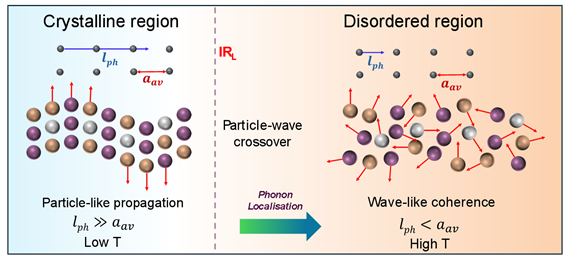
Fig 1 This schematic shows the major findings of this research i.e. how heat transport changes with temperature in Tl2AgI3. Here, lph is the average distance a phonon travels before being scattered, and aav is the average spacing between atoms. At low temperatures, lph≫aav, so heat is carried by phonons moving like particles through an ordered crystal. As temperature increases, Pauling’s third rule mediated cation–cation repulsion induces local structural distortions, leading to strong lattice anharmonicity. This reduces lph so that lph < aav, causing a crossover to wave-like phonon transport.
By combining state-of-the-art synchrotron X-ray pair distribution function measurements, low-temperature thermal transport experiments, Raman spectroscopy, and advanced first-principles theoretical calculation, the team provided a comprehensive picture of this phenomenon. Importantly, they employed a recently developed equation (linearized Wigner transport equation) developed by Prof Swapan K Pati’s group in JNCASR, to distinguish whether heat flows through independent particle-like scattering or through wave-like contributions. Their analysis reveals that, as temperature increases, coherence-driven wave-like transport overtakes particle-based transport around 175 K.
“This is a rare experimental realization of a concept that was largely theoretical,” Prof. Biswas added. “We show that crystalline solids do not have to be strictly particle-like phonon scattering in how they carry heat. Instead, they can access a mixed regime where wave-like coherence dominates, leading to ultralow and glassy thermal conductivity.”
The experimental work was led by first author Dr. Riddhimoy Pathak, Ph.D student of Prof. Biswas, who carried out the synthesis, structural characterization, and thermal transport measurements. The study has a joint first author, Mr. Sayan Paul, who is from the group of Prof. Swapan K. Pati from the Theoretical Sciences Unit (TSU), JNCASR, providing crucial theoretical insight into phonon coherence and wave-like heat transport.
The discovery with implications in thermal management technologies establishes a new design strategy: using chemical rules and local lattice instability to engineer phonon localization and coherence in crystalline solids.
The research benefitted from national supercomputing resources and international synchrotron facilities under the India@DESY programme.
This achievement underscores India’s growing leadership in fundamental materials research and highlights how deep chemical insight, combined with advanced experimental and theoretical tools, can uncover entirely new physical regimes with strong technological relevance.
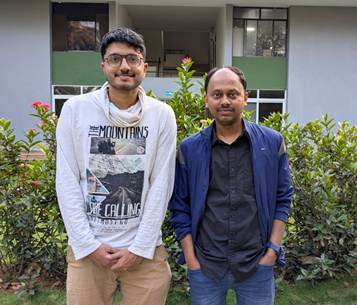
Fig 2: Authors- Dr. Riddhimoy Pathak (left) and Prof. Kanishka Biswas (right)
Publication Link: https://www.pnas.org/doi/10.1073/pnas.2521353123 ;
https://doi.org/10.1073/pnas.2521353123)
*****