Numerical simulations of Sun reveal a ‘Magnetic Cage’ controlling solar storms
Numerical simulations of Sun reveal a ‘Magnetic Cage’ controlling solar storms
Scientists have taken a significant step forward in understanding origins of explosive solar eruptions that can trigger geomagnetic storms which threaten satellites, disrupt power grids, and endanger astronauts.
Predicting which magnetic structures on how the Sun will erupt is a central challenge in space weather forecasting.
In a new study, researchers from the Aryabhatta Research Institute of Observational Sciences (ARIES), an autonomous institute under the Dept. of Science & Technology (DST) , Govt. of India, and their collaborators used computational models that simulate the behavior of electrically conducting fluids like plasma, interacting with magnetic fields (magnetohydrodynamic (MHD) simulations) to uncover two critical factors that govern these eruptions, known as Coronal Mass Ejections (CMEs). The findings reveal that Sun’s global magnetic field acts like a ‘magnetic cage’, while the rapid build-up of magnetic twist provides the key to unlocking it.
The new research, led by Nitin Vashishtha, a PhD student, and Dr. Vaibhav Pant, a scientist, from ARIES, tackles this problem by simulating a CME using the “breakout model,” a leading theory for how these eruptions are initiated. The numerical simulations demonstrated that a stronger global magnetic field acts like a restraining cage, making it significantly harder for a CME to escape the Sun’s gravity. When the researchers simulated a CME under a weaker background field, it erupted successfully.
However, by slightly increasing strength of this background magnetic field, the eruption was stifled and ultimately failed. This result provides strong support for a theory explaining a recent solar puzzle. Solar Cycle 24 was magnetically weaker than solar cycle 23 but paradoxically produced a high number of CMEs. The team’s simulations support the idea that weaker background magnetic field during that cycle lowered the threshold for eruption, allowing even relatively small events to escape into space.
The second major result from the study offers a new tool for forecasting. The team investigated how injecting energy and twist, a property called helicity, into the solar corona affects the outcome. They found that it’s not just the amount of helicity that matters, but the rate at which it builds up.
By tracking a parameter called Absolute Net Current Helicity (ANCH), among other magnetic
parameters such as magnetic energy and Total Unsigned Current Helicity (TUCH), researchers discovered that growth rate of ANCH was the most reliable indicator of an impending eruption.
A slow, gradual increase in ANCH led to a “failed eruption,” where a magnetic structure formed but fell back to the surface while a rapid, steep increase in ANCH consistently preceded a successful CME. In scenarios with fastest ANCH injection, the simulations even produced multiple, successive CMEs from the same region.
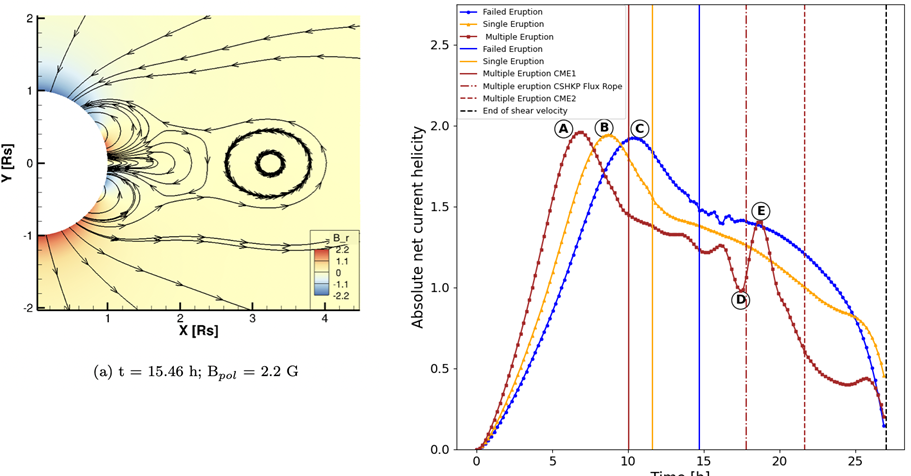
Fig: Left: A snapshot of the numerical simulations showing the solar eruptions being initiated and escaping the Sun. Right: Temporal evolution of absolute net current helicity for three scenarios (blue, yellow, and red for failed, single, and multiple eruptions, respectively). The blue, yellow and red vertical lines represent the flux rope formation time for the failed, single and multiple eruption cases. The black dotted vertical line represents the end of the shear. Time is measured from the start of the shear.
“Our findings indicate that among these parameters, the time rate of absolute net current helicity can serve as the most effective indicator for distinguishing between various eruption scenarios,” the authors said. Dr Vaibhav Pant elaborated on the future direction: “These simulations act as our virtual laboratory for the Sun, allowing us to test the fundamental physics of these massive eruptions. The next frontier is to translate these findings, particularly the importance of the energy build-up rate, into a reliable tool for forecasting real-world space weather events and protecting our vital infrastructure.”
Publication Link: https://doi.org/10.3847/1538-4357/adff54