NITI Aayog Releases Study Reports on Scenarios Towards Viksit Bharat and Net Zero
NITI Aayog Releases Study Reports on Scenarios Towards Viksit Bharat and Net Zero
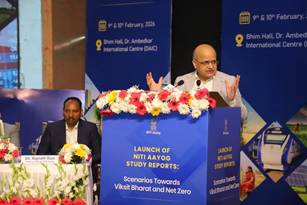
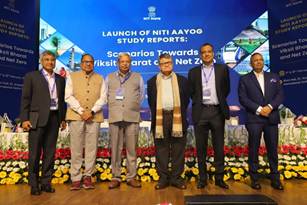
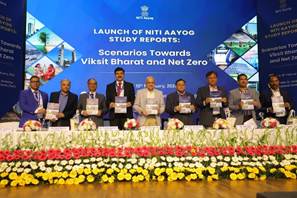
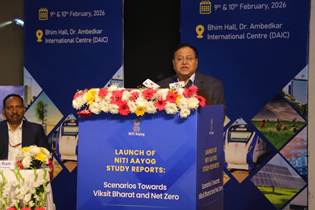
NITI Aayog is releasing eleven study reports on Scenarios towards Viksit Bharat and Net Zero on the 9th and 10th of February 2026. The second set of four reports were released on the morning of 10th February 2026 at an event held at the Ambedkar International Centre, New Delhi.
The reports were released in the presence of Dr. V. K. Saraswat, Member, NITI Aayog; Sh. B.V.R. Subrahmanyam, CEO, NITI Aayog; Dr. Anil Jain, Chairperson, Petroleum and Natural Gas Regulatory Board; Sh. Alok Kumar, former Secretary, Ministry of Power; Sh. Pankaj Agarwal, Secretary, Ministry of Power; and Sh. Santosh Sarangi, Secretary, Ministry of New And Renewable Energy.
The following reports were released at today’s event:
This report assesses the current state and long-term evolution of India’s mobility ecosystem, covering passenger and freight demand, modal composition, technological maturity, and energy use. With passenger and freight transport projected to rise, modal shift, zero-emission vehicles, clean fuels and technologies, and structural shifts toward public and shared mobility solutions and rail and waterway transport are identified as essential components of the transition.
This report examines the various facets of industrial energy transition including industrial output, energy demand, and emissions across major subsectors including steel, cement, aluminium, textiles, and petrochemicals. Increasing electrification, material efficiency and recycling, share of non-fossil energy, and leveraging emerging technologies emerge as the way forward.
This report examines the central role of electricity in India’s development and Net Zero agenda, assessing future electricity demand, low-carbon supply options, system reliability, and investment requirements. Demand is projected to rise sharply due to increasing urbanisation, cooling needs, digitalisation, electric mobility, and green hydrogen production. The report evaluates pathways for rapid electrification, large-scale renewable deployment, and storage and transmission expansion for a reliable, affordable, and progressively clean power system.
This report estimates mineral requirements arising from India’s deployment of clean technologies across key segments such as solar, wind, battery energy storage systems, EVs, and electrolysers. Avenues to de-risk the critical mineral supply chain and meet India’s future requirements through coordinated action across development of domestic resources, international sourcing, institutional reforms, and circularity are discussed.
The launch of the four reports was followed by a panel discussion titled “Technology, Infrastructure, and Minerals: Building Blocks of Net Zero” moderated by Sh. O. P. Agarwal, Distinguished Fellow, NITI Aayog. The panel featured Sh. Suman Bery, Vice Chairperson, NITI Aayog; Sh. Ghanshyam Prasad, Chairperson, Central Electricity Authority; Sh. Sumant Sinha, CEO, ReNew; Sh. Rajat Gupta, Senior Partner, McKinsey & Company; and Sh. Deepak Arora, Head Government Relations, ArcelorMittal Nippon Steel India.
In his address, Dr. V. K. Saraswat, Member, NITI Aayog, shared “Energy, industry and transport are the engine of India’s economy. Along with the challenge of Viksit Bharat 2047 and achieving Net Zero by 2070, lies the opportunity to shift to clean energy, to new fuels like green hydrogen and lock in efficiency gains. India needs to move forward rapidly on implementation; a huge effort is required to bring in the technologies that are needed and to reduce their costs.”
Sh. B.V.R Subrahmanyam, CEO, NITI Aayog, observed “Power, transport and industry, these sectors cover 80% of the energy transition. The composition of India’s future power supply will be largely built from new sources like renewables, nuclear, and green hydrogen. Demand for materials like steel, cement, and aluminium will go up rapidly, even with demand management. The hard-to-abate sectors in industry are the toughest challenge. We will have to electrify to the extent possible, enhance circularity, rely on substitution of industrial process, and increase efficiency. Indian private companies in these sectors are world leaders – the capabilities needed to undertake this transition exists in the country. While critical minerals imports will increase, the decrease in fuels imports will be far greater, so overall India will be in a stronger position. Nonetheless, this will be a path breaking endeavour.”
Dr. Anil Jain, Chairperson, Petroleum and Natural Gas Regulatory Board; stated “The eleven reports being released by NITI fill a big vacuum. The last comprehensive energy assessment was the 2008 Integrate Energy policy, which became a bible of sorts. To make the scenarios possible numerous policy interventions are required on which detailed work will be needed, and the implementation challenge needs to be met. The Ministries should take this work forward.”
Sh. Alok Kumar, former Secretary, Ministry of Power, acknowledged “Renewables are the least cost path for India, whichever model one runs. Trends in technology costs are also favouring renewables – solar and batteries – that’s the destiny for India’s power sector going forward. The power sector needs to better anticipate and plan – generation, transmission, storage, and demand response are important and all need to be taken forward.”
Sh. Pankaj Agarwal, Secretary, Ministry of Power, observed “India needs affordable energy. Electricity is 22% of the current basket and we aspire to reach 40% by 2047. In this transition our Discoms need to remain strong. We’ll surely try to work on the pathways – right now we have the 2030 and 2032 roadmaps, that includes a 500 GW renewables target – but we will keep the longer term pathways in mind.”
Sh. Santosh Sarangi, Secretary, Ministry of New And Renewable Energy said “ I complement NITI Aayog for coming out with such a comprehensive report. It provides us with a roadmap till 2070 that the ministry will work on. It also highlights the implications of how India carries out the green transition; development and green transition are not mutually exclusive, rather mutually inclusive. Grid integration of renewables is a challenge, but no country in the world is backing down from it. There are technological innovations available and anticipating and responding on future changes in technology will be extremely crucial.”
The eleven reports being released by NITI Aayog detail the findings of India’s first government-led, multi-sectoral, integrated study to assess development scenarios that deliver on the Hon’ble Prime Minister’s vision Viksit Bharat 2047 while simultaneously reducing net green-house gas (GHG) emissions to zero by 2070.
NITI Aayog’s study entails a scenario-based analytic modelling exercise that integrates economic growth, India’s development priorities, and climate commitments. The study has been informed by ten inter-ministerial working groups that examined long-term transition scenarios across key domains like macroeconomic aspects of the transition; sectoral low carbon transition in power, transport, industry, buildings, and agriculture; financing for climate action; critical minerals; R&D and manufacturing; and the social implications of the transition. NITI Aayog undertook this comprehensive assessment to inform long-term policy planning.
The full reports can be accessed at:
- Scenarios Towards Viksit Bharat and Net Zero – Sectoral Insights: Transport (Vol. 3)