Artificial Intelligence for Culture and Languages
Artificial Intelligence for Culture and Languages

Key Takeaways
From Cultural Preservation to Cultural Participation
India’s cultural heritage and linguistic diversity shape its social identity and shared knowledge systems. From manuscripts, monuments, performing arts and crafts to oral traditions, folklore and indigenous knowledge, culture in India is created and passed on through many languages, scripts and spoken forms.
According to Census 2011, India’s linguistic landscape includes 22 Scheduled languages and 99 Non-Scheduled languages, spread across multiple language families, along with thousands of mother tongues and tribal languages[1]. The Government of India has undertaken sustained institutional, educational and digital initiatives to preserve and promote our linguistic heritage and the rich traditional knowledge that it holds.
At the core of this effort is the emphasis on leveraging emerging technology including AI, to preserve cultural resources and traditional knowledge, and make it available to people in the language and formats that they are familiar and comfortable with. This calls for democratisation of technology. AI has emerged as a key enabler in this process. By supporting the digitisation and discovery of cultural assets, enabling multilingual and voice-based access, and facilitating engagement at scale, AI helps bridge gaps between heritage and people, tradition and technology. This approach reflects the vision of using AI as technology for humanity, aligned with the goal of “Welfare for All and Happiness for All”.
Building Language as Digital Public Infrastructure
To expand access to culture, knowledge and public services, the Government of India is taking an infrastructure-based approach.
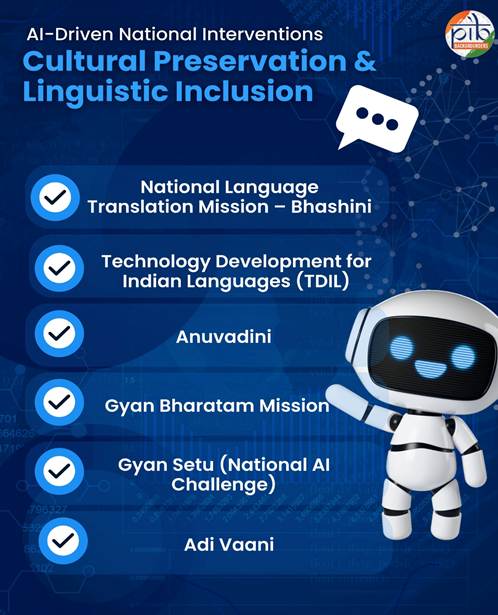
Key pillars of this language infrastructure include:
National Language Translation Mission (NLTM) – BHASHINI[2]
Launched in 2022 under the National Language Translation Mission, BHASHINI was developed to respond to India’s wide linguistic diversity in the digital space. The initiative focuses on building language and voice capabilities directly into digital systems. This allows public platforms to function effectively across the many languages used in the country.
BHASHINI addresses three key barriers together:
At a system level, BHASHINI is building multilingual AI as national digital public infrastructure. It provides language services such as translation, speech-to-text, text-to-speech, transliteration and document understanding across Indian languages, allowing platforms to add language and voice features without building them from scratch.
BHASHINI is already operating at scale:
Its strength lies in collaboration. Research institutions, language experts, startups, state governments and industry partners jointly contribute to the platform, ensuring that language models improve through real-world use and local participation.
As a foundational language layer, BHASHINI turns linguistic diversity into practical digital access, enabling people to engage with information, culture and public services in languages and formats they understand.
At the Kashi Tamil Sangamam event in Varanasi, Prime Minister Narendra Modi used the BHASHINI AI platform during his address. His Hindi speech was translated in real time into Tamil so that Tamil-speaking attendees could understand the address directly in their language, demonstrating BHASHINI’s real-time translation capability in a live cultural exchange context.
BHASHINI powered the Kumbh Sah’AI’yak chatbot, a multilingual, voice-enabled assistant used at Maha Kumbh 2025 to provide navigation and event information to pilgrims in 11 languages (Hindi, English and nine others). It also supported features like a digital Lost & Found solution with real-time text and voice translation to make the event more accessible for attendees from diverse linguistic backgrounds.
As foundational language infrastructure, BHASHINI translates diversity into access, helping people engage with information, culture and public services in their own languages and formats — a critical step toward inclusive participation and empowerment.
Technology Development for Indian Languages (TDIL)[5]
TDIL is a long-standing Government of India programme that laid the foundational technology base for Indian language computing, covering scripts, speech and text across multiple Indian languages.
As a foundational language technology programme, TDIL enabled India’s transition from language research to scalable language infrastructure, eventually directly supporting platforms such as BHASHINI and strengthening inclusive access to digital, cultural and knowledge ecosystems.
Anuvadini (AICTE)
Anuvadini is an AI-based multilingual translation platform developed by the All India Council for Technical Education (AICTE) to enable large-scale translation of academic, technical and knowledge content into Indian languages.
As an AI-driven language access platform, Anuvadini expands access to knowledge and skills in Indian languages. By enabling participation in education, skilling and cultural knowledge systems, it contributes to social empowerment and livelihood opportunities.
AI for Cultural Heritage, Knowledge Systems and Linguistic Diversity
To preserve India’s vast cultural legacy while enabling wider public access and participation, the Government of India is deploying AI across heritage preservation, traditional knowledge systems and linguistic diversity, with a focus on scale, discoverability and inclusion.
Gyan Bharatam Mission[7]
It is national mission for the survey, documentation, digitisation and dissemination of India’s manuscript heritage and traditional knowledge systems, including creation of a National Digital Repository.
The mission will ensure cultural heritage to move from physical archives to shared digital access, supporting long-term preservation and increased public engagement.
Gyan-Setu (National AI Innovation Challenge under Gyan Bharatam)[9]
Gyan-Setu was launched as a national challenge to source AI-led solutions for manuscript preservation, decipherment, restoration and access.
The initiative created a pipeline of deployable AI solutions, strengthening collaboration between cultural institutions and the AI ecosystem.
Adi Vaani – AI Platform for Tribal Languages[10]
Adi Vaani is an AI-based platform for the preservation, promotion and revitalisation of tribal languages, which are central to India’s cultural and oral heritage.
Enabling Participation and Opportunity through AI[12]
As AI improves access to culture, language and knowledge, the next step is to turn this access into economic opportunity and social empowerment. This is especially important for India’s cultural and creative sectors, where livelihoods depend on traditional skills, local knowledge and community-based practices.
Artisans, craftspeople and cultural practitioners make up a large part of India’s informal and creative economy. When designed to be inclusive and sensitive to local context, AI can support these livelihoods by improving visibility, productivity, skills and participation in digital markets—while preserving cultural identity.
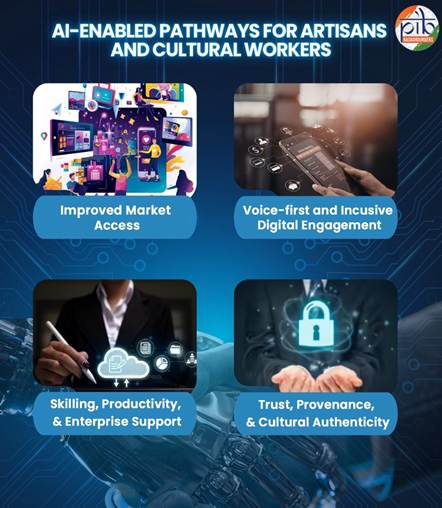
AI-Enabled Pathways for Artisans and Cultural Workers
By building language access, voice-based tools and cultural understanding into AI systems, artisans and cultural workers become active users of technology, not just beneficiaries. In this way, AI supports social empowerment by strengthening dignity of work, sustainable livelihoods and India’s cultural and creative traditions.
Advancing Inclusive AI for Culture, Languages and Livelihoods
As India expands the use of AI across public systems, the main aim is to ensure that technology leads to greater cultural participation, social empowerment and sustainable livelihoods. Recent policy thinking, including NITI Aayog’s report on AI for Inclusive Societal Development, points to the following key aspects for better use of AI in the public space[13]:
These efforts will position AI not merely as a technological tool, but as a public good that reflects India’s cultural and linguistic diversity. This human-centred approach reinforces the idea of technology for humanity—AI that listens, understands and responds to people’s lived realities. By aligning AI deployment with inclusion, participation and opportunity, India can ensure that its cultural heritage and creative communities continue to remain active contributors to a digitally empowered and socially inclusive future.