Decoding India’s Medical Heritage
Decoding India’s Medical Heritage
In a significant step towards preserving and advancing India’s classical medical heritage, the Central Council for Research in Ayurvedic Sciences (CCRAS), Ministry of Ayush, Government of India, in collaboration with the Central Sanskrit University (CSU), New Delhi, successfully conducted a 15-day Transliteration Capacity Building Workshop on Ayurvedic Manuscripts at the CSU Puranattukara (Guruvayoor) Campus in Thrissur, Kerala, from 12 to 25 January 2026.
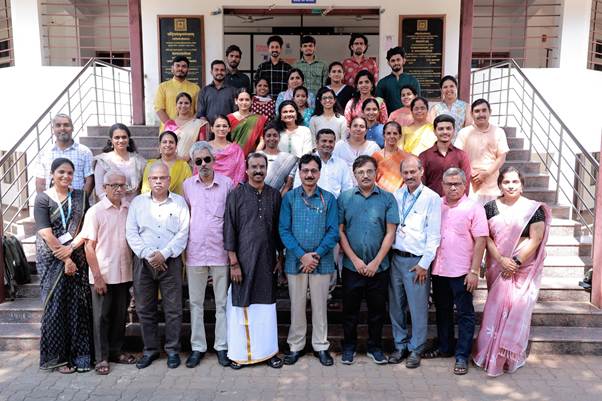
The two-week residential programme brought together 33 scholars, including 18 from Ayurveda and 15 from Sanskrit, fostering an interdisciplinary approach to manuscript studies.
Organised under the Memorandum of Understanding between CCRAS and CSU, the workshop was part of CCRAS’s national initiative to document, digitise, and research-based utilise classical Ayurvedic manuscripts. The two-week residential programme brought together 33 scholars, including 18 from Ayurveda and 15 from Sanskrit, fostering an interdisciplinary approach to manuscript studies.
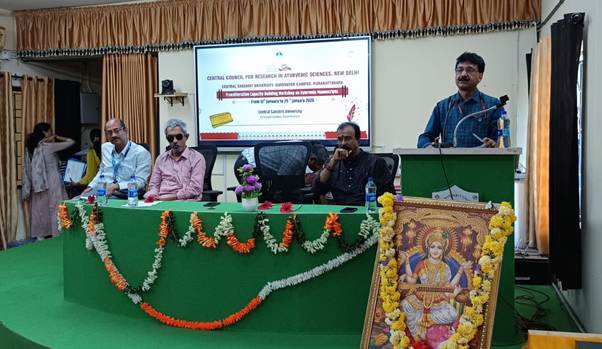
Valedictory function of the workshop
The training programme covered key areas such as manuscriptology, palaeography, technical Ayurvedic terminology and script orientation, with specialised Lipi Parichaya sessions on Grantha and Vattezhuthu scripts. A strong emphasis was placed on hands-on transliteration training in Grantha, Medieval Malayalam, and Vattezhuthu, enabling participants to work directly on original palm-leaf manuscripts and to generate verifiable scholarly outputs within a short time.
As a major scholarly outcome of the workshop, five rare and previously unpublished Ayurvedic manuscripts were successfully transliterated and are now available for advanced research. These include Dhanwanthari (Vaidya) Chinthamani, comprising 146 palm-leaf pages and transliterated from Grantha into Sanskrit; Dravyashuddhi, a 110-page Grantha manuscript transliterated into Sanskrit; Vaidyam, a 59-page Medieval Malayalam manuscript transliterated into Malayalam; Roga Nirnaya, Part I, consisting of 75 pages transliterated from Medieval Malayalam into Malayalam; and Vividharogangal, a 78 palm-leaf manuscript in Vattezhuthu transliterated into both Malayalam and Sanskrit.
Addressing the valedictory function of the workshop, Prof. Vaidya Rabinarayan Acharya, Director General, CCRAS, stated that the workshop was the second collaborative programme with the Central Sanskrit University under the Ayurveda Manuscript Research Initiative of CCRAS. He noted that during the first such workshop conducted at the CSU Puri Campus in Odisha, 14 Ayurvedic manuscripts were transliterated, reflecting the continuity and expansion of this national effort.
Prof. K. K. Shine, Director of the CSU Guruvayoor Campus, along with Prof. K. Vishwanathan, reiterated the university’s commitment to future collaboration with CCRAS, particularly for the systematic preservation, scholarly processing and revival of Malayalam Ayurvedic manuscripts, which constitute a vital component of India’s regional medical heritage.
The programme was coordinated by Prof. K. Vishwanathan of CSU and Dr. Parvathy G. Nair of CCRAS. The valedictory session was attended by Dr. V. C. Deep, In-charge of CCRAS–National Ayurveda Research Institute for Panchakarma (NARIP), along with senior officials, academicians and subject experts.
The workshop was widely appreciated for its integrated approach, which involved Ayurveda and Sanskrit scholars, and for delivering tangible research outcomes within a limited timeframe. CCRAS stated that such initiatives will strengthen evidence-based Ayurveda, preserve regional medical traditions and support the long-term conservation of India’s classical medical knowledge.