Electronics Development Fund
Electronics Development Fund
Introduction
India’s electronics sector has witnessed a remarkable transformation in recent years, driven by a series of government initiatives and industry reforms. The country is steadily emerging as a global hub for electronics design and manufacturing, a sector marked by rapid technological change and innovation.
To strengthen this momentum and nurture a robust innovation ecosystem, the Government of India launched the Electronics Development Fund (EDF) on 15 February 2016. The Fund aims to promote research, development, and entrepreneurship in the fields of electronics, nano-electronics, and information technology.
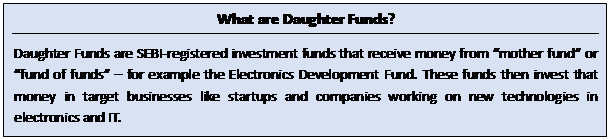
The EDF functions as a Fund of Funds, designed to invest in professionally managed Daughter Funds such as early-stage angel and venture funds. These Daughter Funds, in turn, provided risk capital to startups and companies developing new technologies. By doing so, the EDF played a crucial role in building a self-sustaining electronics ecosystem that encourages innovation, product design, and intellectual property creation within the country.
Goals and Strategic Objectives
EDF has been established to create a strong foundation for innovation and research in India’s electronics and information technology sectors. It aims to strengthen the ecosystem by supporting funds that provide risk capital to startups and companies engaged in developing cutting-edge technologies.
Key objectives include:
Salient Operational Features of the Fund
The Electronics Development Fund (EDF) operates through a flexible and professionally managed structure designed to promote efficient investment and innovation in the electronics and IT sectors. Its framework ensures transparency, market responsiveness, and strategic allocation of funds.

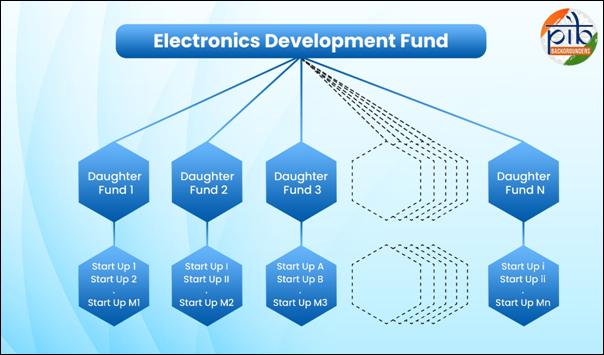
Each Daughter Fund supported under the scheme is required to be registered in India and comply with all applicable laws and regulations, including the SEBI (Alternative Investment Funds) Regulations, 2012, as Category I or Category II AIFs. This ensures that all participating funds operate within a well-defined regulatory framework while aligning with EDF’s broader goal of fostering research, entrepreneurship, and technological advancement.
Main Features:
Achievements and Impact
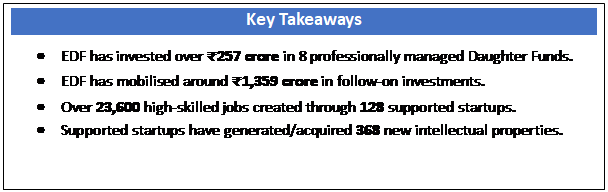
The Electronics Development Fund (EDF) has made remarkable progress in nurturing India’s innovation ecosystem. EDF has drawn a total of ₹216.33 crore from its contributors, including ₹210.33 crore from MeitY.
The supported startups operate in frontier areas such as Internet of Things (IoT), Robotics, Drones, Autonomous Vehicles, HealthTech, Cyber Security, and Artificial Intelligence and Machine Learning, positioning India as a hub for advanced technological innovation.
S. No.
Name of Daughter Fund
Amount Invested by EDF (₹ crore)
Daughter Fund Investment (₹ crore)
Total No. of Startups Funded
1
Unicorn India Ventures Trust
15.82
63.64
17
2
Aaruha Technology Fund – 1
6.75
26.22
13
3
Endiya Seed Co-creation Fund
30.00
137.03
12
4
Karsemven Fund
24.00
83.43
17
5
pi Ventures Fund 1
15.00
186.53
15
6
YourNest India VC Fund II
43.15
185.54
19
7
Ventureast Proactive Fund – II
97.75
425.7
18
8
Exfinity Technology Fund Series II
25.30
227.68
17
Total
257.77
1335.77
128
As on 30 September 2025:
Conclusion
The Electronics Development Fund has played a pivotal role in nurturing innovation and entrepreneurship in India’s electronics and IT sectors. By enabling access to risk capital, it has supported startups working on advanced technologies and contributed to expanding domestic design and intellectual property creation. The Fund’s transparent and professionally managed framework has helped build confidence among investors and strengthened the foundation for a vibrant, self-reliant electronics ecosystem in the country.
References:
MEITY: